November 10, 1918 – Terms of Armistice Agreed Upon
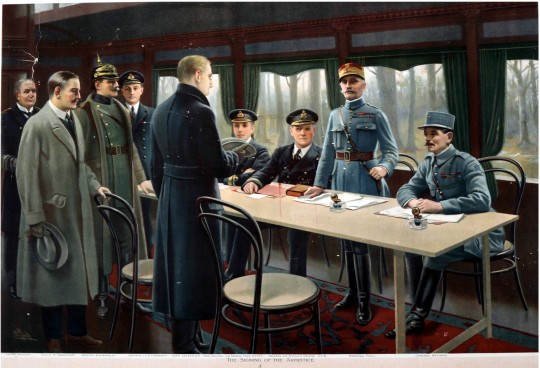
Pictured – The Allied delegates. Foch stands second from the right.
Terms of victory and defeat were agreed upon on November 10 in a train car sitting on a quiet line in the forest of Compiègne, near Paris. German negotiators arrived the previous morning, headed by Major-General Detlof von Winterfeldt. In 1870 Winterfeldt’s father had dictated the terms of the Napoleon III”s surrender, but his son did not remind the French of that fact. He and the other delegates filed into the train car slumped and beaten. Foch brightened at the sight. “When I saw them in front of me,” he wrote, “aligned along the other side of the table, I said to myself: ‘That’s the German Empire!”
The Germans asked for lenient terms. A civilian politician spoke for them, the moderate Catholic Secretary of State Matthias Erzberger, who Prince Max thought would be amenable to the French. Erzberger made the case that Germany should be kept strong as a buffer against Bolshevism. Foch cut Erzberger short. “You are suffering from a loser’s malady,” he said. Erzberger requested that at the least there should only be a The Allies, especially the French, would not hear it. After four longs
years of war on their own soil they could accept nothing less than total
victory. “No,” said Foch. “I represent here the Allied Governments, who have settled their conditions. Hostilities cannot cease before the signing of the Armistice.”
The Germans accepted terms and agreed to sign an armistice the next morning. Under its terms they would have to evacuate Belgium, France, Luxembourg, and Alscace-Lorraine, repatriating their populations who had been deported to Germany as forced laborers. They would also have to return all their prisoners, plus captured merchant ships, plus the entirety of their U-boat fleet and most of their surface ships, including ten battleships and six battlecruisers. The Army had to surrender 5,000 artillery guns, 25,000 machine-guns, 3,000 trench mortars, and 1,700 airplanes, as well as 5,000 railway engines ,150,000 train wagons, and 5,000 trucks. German troops had to return behind the 1914 borders, abandoning the vast eastern annexations. On top of that, Entente troops would occupy all of western Germany up to the Rhine, and hold the cities of Mainz, Coblenz, and Cologne across the river. Reparations for “damage done” in Belgium and France would be agreed upon later. The Entente wanted to ensure that Germany’s fighting power could not be restored.
The signing of the armistice, by Maurice Pillard Verneuil. The Entente is represented by General Weygand, at the right, Foch, standing, and British admirals Wemyss and Hope. In front of them stands Erzberger, Winterfeld in his helmet, Foreign Secretary Count Obendorff and Captain Vanselow of the Imperial German Navy.
The German delegates did what they could to ease the terms, which was not much, and agreed to sign the armistice the next morning at 5. “A nation of seventy million suffers but does not die,” declared Erzberger in a last bit of defiance. Foch sent word to all Allied generals. “Hostilities will cease on the entire front November 11th at 11.00 a.m. French time.” In the meantime, his forces continued to fight, trying to take as much ground as possible to strengthen the Allied hand at peace negotiations. The Americans in particular launched attack after attack up to the minute of the armistice, seeking to gain by blood the glory they had not had time to win. Eleven thousand men became casualties on the last day of battle. It was a perfect metaphor for a war that had long been continuing with a terrible inertia of its own.
The armistice would end the war, but it would leave much else unresolved. The victors divided the spoils and the defeated stewed in resentment, plotting their revenge. In 1921 right-wing thugs murdered Erzberger, for the crime of “betraying” Germany. Across Europe and Asia another wave of violence broke out, fought my men who returned home bitter and brutalized. Millions more came back traumatized, mutilated, disillusioned. The war created new categories of pain: the shell-shocked, men whose nerves had gone to bits in bombardments, and the “Gueules cassées,” as the French called them, the “broken faces,” whose bodies had been mutilated beyond recognition. They were reminders of the war, and people shunned them.
One such victim was an Austrian-born
lance-corporal who had been gassed near Ypres several weeks before the armistice. He learned of the terms from his hospital bed. By his own account, the humiliation and rage he felt triggered a second bout of blindness. Two decades later he would lead Germany to war again, and
in 1940 would have the French sign their own surrender in the same
railway carriage in the quiet forest of Compiègne.
Where’s the Peace And Justice? Canada’s New Foreign and Defence Policies
Every Canadian needs to see this video of the Keynote speech delivered by Tamara Lorincz at the 2018 Perspectives on Peace Symposium; perfect Remembrance Day fare.
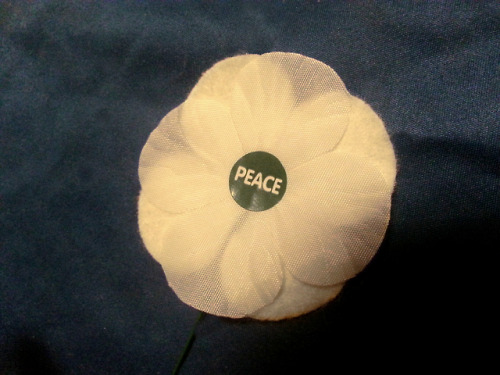
In 1926, a few years after the introduction of the red poppy in the UK, the idea of pacifists making their own poppies was put forward by a member of the No More War Movement (as well as the proposal that the black centre of the British Legion’s red poppies should be imprinted with “No More War”).[1] Their intention was to remember casualties of all wars, with the added meaning of a hope for the end of all wars; the red poppy signified only the British military dead.[2] However, they did not pursue the idea.[1] The first white poppies were sold by the Co-operative Women’s Guild in 1933[3]. The Peace Pledge Union (PPU) took part in their distribution from 1936, and white poppy wreaths were laid from 1937 as a pledge to peace that war must not happen again[1][4]. Anti-war organisations such as the Anglican Pacifist Fellowship now support the White Poppy Movement.
Those who promote the wearing of white poppies argue that the red poppy also conveys a specific political standpoint, and point to the divisive nature of the red poppy in Northern Ireland, where it is worn mainly by unionist but boycotted by Irish republicans.[5]
In 2018, St John Ambulance allowed its volunteers to wear the pacifist white poppy for the first time.[6]
Sales of white poppies steadily rose throughout the 2010s, often causing supporters of the PPU to become targets of abuse. On Thursday 1st November In 2018 Sales of white poppies were higher than in any previous year since white poppies were founded in 1933. As of 7th November 2018, 119,555 white poppies had been sold. The previous record was 110,000 white poppies in 2015. Last year, the figure was 101,000. Until 2014, the record was around 80,000 in 1938.[7][8]
Children’s author Michael Morpurgo his decision to wear a white poppy alongside his red one in a Radio Times article: “Wearing the red poppy for me is not simply a ritual, not worn as a politically correct nod towards public expectation. It is in honour of them, in respect and in gratitude for all they did for us. But I wear a white poppy alongside my red one, because I know they fought and so many died for my peace, our peace. And I wear both side by side because I believe the nature of remembrance is changing, and will change, as the decades pass since those two world wars.” [12]
New Zealand
In New Zealand, a White Poppy Annual Appeal has been run since 2009 by Peace Movement Aotearoa in the week preceding Anzac Day, with all proceeds going to White Poppy Peace Scholarships.[13] The appeal was controversial for some, with Veterans’ Affairs Minister Judith Collins claiming the white poppy appeal was “incredibly disrespectful to those who served their country”.[14]
White poppies have also been worn in New Zealand to mark Remembrance Day. In previous years, the annual white poppy appeal was run as a fundraiser for the Campaign for Nuclear Disarmament around the time of Hiroshima Day in August. Responsibility for organising the annual appeal was transferred to Peace Movement Aotearoa, as the Campaign for Nuclear Disarmament in New Zealand closed down in 2008.[13]
Controversy
The Royal British Legion has no official opinion on the wearing of white poppies, stating that it “is a matter of choice, the Legion doesn’t have a problem whether you wear a red one or a white one, both or none at all”.[15] However, opponents[16] of the white poppy argue that the traditional red poppy already encompasses the sentiments claimed for the white poppy, such as “remembering all victims of war”, and consider that it undermines the message of remembrance. Some groups such as Northern Irish nationalists though still see the red poppy as primarily remembering the British dead and not those who were victims in wars against the British, hence the belief that the red poppy is a political symbol. [17] In the 1930s, when the white poppy was first established, some women lost their jobs for wearing them.[18] Others are concerned that the money raised by the white poppy appeal may affect the funds raised for the Royal British Legion by the red poppy appeal.[19]
In 1986, John Baker, Bishop of Salisbury, stated in his diocesan newsletter that he had been asked about the appropriateness of the White Poppy. Baker responded “let’s not be hurt if we see a white poppy…there is plenty of space for red and white to bloom side by side.”[20] Salisbury MP Robert Key disagreed, and later that year asked British prime minister Margaret Thatcher her opinion on the issue. Thatcher expressed her “deep distaste” for the symbol during prime minister’s questions.[21] In response, the White Poppy campaign received much media coverage in Britain.[20] The Daily Star ran several articles criticising the White Poppy campaign.[20] In The Guardian, artist Steve Bell published a cartoon satirizing Thatcher’s opposition to White Poppies, which he allowed the Peace Pledge Union to republish.[20]
In November 2014, white poppy wreaths on the Aberystwyth War Memorial had to be replaced after they were removed from the Memorial and thrown in a bin.[22]
Tens of thousands of protesters marched through the streets of downtown Montreal on Saturday with hope, desperation and urgency, calling on elected leaders to act now to stop climate change — or they will be held responsible.
Desperation because despite all the previous marches and calls on government to act, the planet is still heading toward catastrophe.
Urgency because the latest United Nations report on climate change released in October says it’s not vague “future generations,” but today’s pre-teens that will feel the heat and effect as adults.
Hope because, well, without hope, what is there?
“We’re calling on all politicians to bring our voices to Parliament,” said Dominic Champagne, a theatre director, author and leader of the movement the Planet goes to Parliament, which organized the march, as he addressed the crowd.
“If you do, you will have these tens of thousands of people supporting you. … But if you don’t, they will not be duped.”
Can we have these sorts of numbers in English Canada too, please?
Yeah.
Like as much as English Canada makes fun of Quebec at least they have their priorities straight. When the government fails on healthcare, education, the environment, etc, Quebecois show up.
The rest of Canada is so apathetic about politics. Quebec’s activism is inspiring.
Even on major issues in English Canada like Kinder Morgan pipeline protests or protests against Doug Ford, crowd sizes rarely number beyond a few hundred.
The CRTC has proposed a code of conduct
for Canadian ISPs that would “easy to understand, and make it easier
for Canadians to switch providers to take advantage of competitive
offers” – but the new plan doesn’t address the epidemic of fraudulent
promises made by Canadian ISPs (that’s part of a separate, ongoing
government inquiry). Canadians hate their ISPs, with complaints rising
by 36% in 2017. Canada has one of the world’s most concentrated telcoms
sectors, with the big cable and phone companies routinely gobbling up
each other (and many media companies) with nary a peep from Canada’s
asleep-at-the-wheel competition regulators.
Perspectives On Peace: Where’s the Peace And Justice? Canada’s New Foreign and Defence Policies
Tamara Lorincz looks at the intersection of Climate Action and Military Policy in her keynote presentation at the 2018 KWPeace Perspectives On Peace Symposium.
Tamara Lorincz tlorincz@balsillieschool.ca PhD Student Member of • Canadian Voice of Women for Peacehttps://vowpeace.org/ Member of • Global Network Against Weapons and Nuclear Power in Spacehttp://www.space4peace.org/