November 10, 1918 – Terms of Armistice Agreed Upon
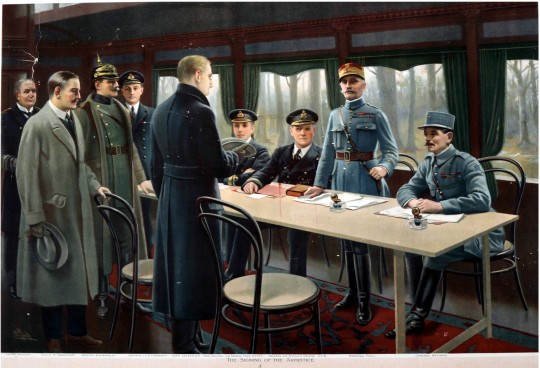
Pictured – The Allied delegates. Foch stands second from the right.
Terms of victory and defeat were agreed upon on November 10 in a train car sitting on a quiet line in the forest of Compiègne, near Paris. German negotiators arrived the previous morning, headed by Major-General Detlof von Winterfeldt. In 1870 Winterfeldt’s father had dictated the terms of the Napoleon III”s surrender, but his son did not remind the French of that fact. He and the other delegates filed into the train car slumped and beaten. Foch brightened at the sight. “When I saw them in front of me,” he wrote, “aligned along the other side of the table, I said to myself: ‘That’s the German Empire!”
The Germans asked for lenient terms. A civilian politician spoke for them, the moderate Catholic Secretary of State Matthias Erzberger, who Prince Max thought would be amenable to the French. Erzberger made the case that Germany should be kept strong as a buffer against Bolshevism. Foch cut Erzberger short. “You are suffering from a loser’s malady,” he said. Erzberger requested that at the least there should only be a The Allies, especially the French, would not hear it. After four longs
years of war on their own soil they could accept nothing less than total
victory. “No,” said Foch. “I represent here the Allied Governments, who have settled their conditions. Hostilities cannot cease before the signing of the Armistice.”
The Germans accepted terms and agreed to sign an armistice the next morning. Under its terms they would have to evacuate Belgium, France, Luxembourg, and Alscace-Lorraine, repatriating their populations who had been deported to Germany as forced laborers. They would also have to return all their prisoners, plus captured merchant ships, plus the entirety of their U-boat fleet and most of their surface ships, including ten battleships and six battlecruisers. The Army had to surrender 5,000 artillery guns, 25,000 machine-guns, 3,000 trench mortars, and 1,700 airplanes, as well as 5,000 railway engines ,150,000 train wagons, and 5,000 trucks. German troops had to return behind the 1914 borders, abandoning the vast eastern annexations. On top of that, Entente troops would occupy all of western Germany up to the Rhine, and hold the cities of Mainz, Coblenz, and Cologne across the river. Reparations for “damage done” in Belgium and France would be agreed upon later. The Entente wanted to ensure that Germany’s fighting power could not be restored.
The signing of the armistice, by Maurice Pillard Verneuil. The Entente is represented by General Weygand, at the right, Foch, standing, and British admirals Wemyss and Hope. In front of them stands Erzberger, Winterfeld in his helmet, Foreign Secretary Count Obendorff and Captain Vanselow of the Imperial German Navy.
The German delegates did what they could to ease the terms, which was not much, and agreed to sign the armistice the next morning at 5. “A nation of seventy million suffers but does not die,” declared Erzberger in a last bit of defiance. Foch sent word to all Allied generals. “Hostilities will cease on the entire front November 11th at 11.00 a.m. French time.” In the meantime, his forces continued to fight, trying to take as much ground as possible to strengthen the Allied hand at peace negotiations. The Americans in particular launched attack after attack up to the minute of the armistice, seeking to gain by blood the glory they had not had time to win. Eleven thousand men became casualties on the last day of battle. It was a perfect metaphor for a war that had long been continuing with a terrible inertia of its own.
The armistice would end the war, but it would leave much else unresolved. The victors divided the spoils and the defeated stewed in resentment, plotting their revenge. In 1921 right-wing thugs murdered Erzberger, for the crime of “betraying” Germany. Across Europe and Asia another wave of violence broke out, fought my men who returned home bitter and brutalized. Millions more came back traumatized, mutilated, disillusioned. The war created new categories of pain: the shell-shocked, men whose nerves had gone to bits in bombardments, and the “Gueules cassées,” as the French called them, the “broken faces,” whose bodies had been mutilated beyond recognition. They were reminders of the war, and people shunned them.
One such victim was an Austrian-born
lance-corporal who had been gassed near Ypres several weeks before the armistice. He learned of the terms from his hospital bed. By his own account, the humiliation and rage he felt triggered a second bout of blindness. Two decades later he would lead Germany to war again, and
in 1940 would have the French sign their own surrender in the same
railway carriage in the quiet forest of Compiègne.