Comment on Finding a Digital Public Domain Book by Laurel L. Russwurm

As a Canadian myself I am quite interested in Project Gutenberg Canada, and if I ever get free time (not in the forseeable future, anyway) that’s where I would be likely to volunteer my help.

Having just learned Australia has followed England into being bullied to up their copyright terms from Life +50 to Life +70 I am frankly amazed (and terribly pleased) that Canada has not. Perhaps the nearly universal opposition to same in our Copyright Consultation made some little impact after all.

Still, in my online efforts to plug the Public Domain and fight against copyfraud, I don’t tag things I know are PD in Canada but bnot elsewhere as “Public Domain” because first and foremost I don’t want anyone to find themselves DMCAed, fined, or winding up in jail (or worse) through the brutal application of today’s crazy copyright law.

I thoroughly agree with your policy of re-releasing improved Public Domain works back into the Public Domain. I do that too, although so far I’ve not remade any eBooks, just art), and I guess what surprises me the most is how many people don’t.

Comment on Finding a Digital Public Domain Book by Indi

Oh, I totally forgot to mention – if you’re looking for a quality EPUB reader, one of the better options is one built into a browser. Everybody has a browser, after all, and the quality of HTML5/CSS3/SVG1.1 support is usually top-notch… *MUCH* better than in your average standalone EPUB reader. In fact, even the better standalone EPUB readers basically use browsers internally. (Calibre, for example, doesn’t use FBReader, it uses its own EPUB viewer that’s based on WebKit (ie, basically Chromium/Chrome)).

Firefox has Lucifox, and Chromium/Chrome has Readium. Both are plenty good enough for reading, and both even offer limited library management if you want it (if you want full library management, there’s always Calibre). Both are free software – Lucifox is GPL3, Readium is BSD-licenced. The interesting thing about Readium is that it’s actually the reference implementation used by the IDPF (the people who write the EPUB specification) to show full EPUB 3 support.

Comment on Finding a Digital Public Domain Book by Indi

I’m so pleased to see Gutenberg Canada getting a mention. It’s way smaller than Gutenberg Project actual, and in *DIRE* need of cleanup and organization (and it’s ugly as sin to look at), but it has things that are simply not available on Gutenberg actual because that site uses US copyright law… which is much nastier than Canadian copyright law. Gutenberg Canada actually has stuff that wouldn’t be allowed on Gutenberg actual, plus a lot of specifically Canadian stuff.

The biggest complaint I have about most public domain ebooks is that they’re of such poor quality. Both the Gutenberg Project and Gutenberg Canada insist on plain text versions… which is fine for simple books, but pretty much pointless for texts with tables, diagrams, figures, or equations. And both focus on simply reproducing the text, with no concern whatsoever for the semantics (for example, they mark all italics up with [i] (or worse, just uppercase), whether they’re just italics for display purposes or for actual emphasis), which makes them hard to use for people who have accessibility issues (people who need to use a screen reader, for example).

For years, one of my hobbies has been taking public domain works and making *quality* ebooks out of them – and by quality I don’t just mean they look good (I try to make them look as much like the originals as practical), I mean they are coded with semantic markup technologies, so they are accessible even to readers who can’t read plain text without assistance. I actually have *dozens* of books done, but the vast majority are still under copyright. (Originally I just did this for myself, to create nice digital editions for physical books I own that are falling apart.) One of my resolutions this year was to get a little more organized about that, to focus on public domain texts, and to actually publish them online for others to use too, so I actually put together a simple site listing them at http://indi.frih.net/books/ – there are only three books there so far (though I’ll probably finish Kant’s “Perpetual Peace” this week), but as I go through all my old stuff, pick out the public domain works, and update them, it should expand quite a bit.

Of course, every ebook I make is released back into the public domain – DRM-free – even including anything I added (like cover images, for example).

The focus is on philosophical and scientific texts, and maybe I’ll do some science fiction and mystery works, too… basically anything that catches my fancy, I suppose (it is a hobby after all). I suppose they’re rather niche interests, but they’re my interests, so, so it goes. But if there’s anything you’re really hankering for – or anything you know someone else is really hankering for – feel free to mention it to me; I might put it on the list. (I would suppose the easiest way for you to get in touch with me is via Status.Net/GNU Social – I’m @indi on quitter.se – but there’s also a contact page on the site that I’m probably going to add a contact/request form to… someday.)

Je Suis Charlie – Intolerence

I Understand Kaveh Mousavi is being as fair as anyone in his situation can be when he writes: Muslim reformists should not deceive themselves into thinking that this extremism is only a tiny minority of “fake” Muslims that is being exaggerated by the hostile colonialists media. While extremists such as these shooters indeed are a […]

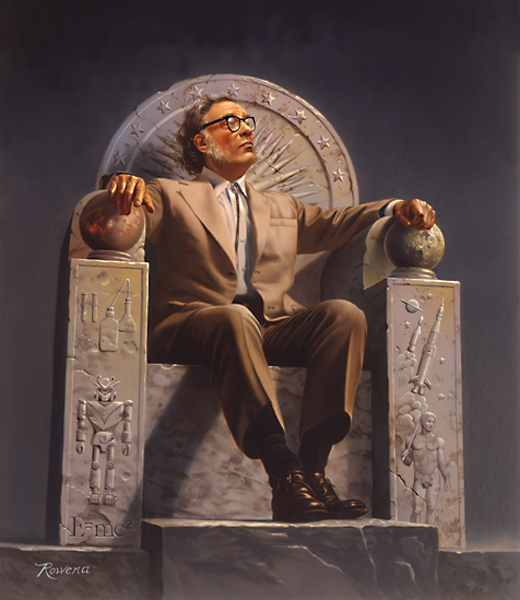
Happy Birthday Isaac Asimov

Isaac Asimov by Rowena Morrill

Isaac Asimov
born  Isaak Yudovich Ozimov
(circa January 2, 1920 — April 6, 1992)
painting by Rowena Morrill

[reblogged from   visual laurel:
Happy Birthday Isaac Asimov]

I may be a little late here, but if memory serves, although January 2nd would have been  Isaac Asimov’s birth date of record, it seems to me he told some tale about the actual records being confused due to his family’s emigration from Russia.  Whatever else, Asimov was always interesting.

Isaac Asimov was a hugely important influence for me.   I loved his books when I first stumbled on “Foundation” in my high school library; Ike took me by the hand and helped me find my way through the worlds of science fiction.

As a reader I loved his bare bones accessible writing style.  Devoid of superfluous descriptive padding, his plots were crisp and he wrote just what he needed to bring the story to life.

The good Dr. Asimov’s exploration of robotics throughout his powerful stories was breathtaking, but his non-fiction was excellent, too, because he was brilliant at explaining things so that anyone could understand.  (I rather think Malcolm Gladwell is like Asimov without the fiction.)  And I have to say, between Asimov’s stories and non-fiction alike, I learned more science from him than I did from any teacher I ever had in school.   My grade nine physics teacher was a dead loss at getting through to me; and I’m certain the only reason I passed was because he didn’t want to have to try again.

Much as I loved science fiction, as a writer, I’ve never dared write in this genre because I’ve always felt I lacked the requisite grounding in science,  and always thought the only SF I’d want to write would be hard science fiction.  (That may change in future.)  When I and my friend, Canadian Trekkies Association co-founder Susan Schmidt, published our very first Star Trek and science fiction Fanzine Canektion in the 1970’s, she tackled the science fiction writing while I handled reviews, art and design.  I actually mailed a copy off to the good doctor, and was gobsmacked to receive a personal thank you note on a postcard (with a wonderful “Very impressive looking” quote).  One of my greatest regrets was losing that postcard at my very first science fiction convention.

I was quite taken with the glimpses of Isaac Asimov the person through the humour in his Hugo Winners introductions.  Yet the only book he wrote that was pretty nearly unreadable was the first volume of his autobiography, “In Memory Yet Green,”   I paid big bucks for the hardcover version, but after the agony of struggling through it, I knew nothing would ever entice me to read it again so I gave it away.  Fortunately he took a better crack at it in later life with “I, Asimov

One of the best things about Asimov’s writing is that he wrote characters who were human beings.  Better yet, it didn’t matter whether they were men, women or robots. The strong and interesting women characters that Asimov wrote — women like Dr. Susan Calvin, Edith Fellowes and Bayta Darell — certainly made a positive impression on me as a young woman.   This was pretty radical for his time, especially when you consider that even today some male authors have difficulty writing plausible female characters.   Asimov wrote women who existed in their own right; they weren’t just tossed in to be a damsel in distress, a femme fatale or love interest. They were real people.  I’ve often been told my own characters live and breathe, and I think this is in no small part due to his example; he showed me how.

I never tire of Asimov’s stories, having read some over and over again, which is why I am saddened by the absence of his work on the shelves of public libraries today.  This state of affairs means most of today’s young people will not have the opportunity to stumble across his books the way I did, simply because they aren’t there.

I expect this probably has as much to do with copyright as much as anything.  Keep his work locked down tight so as to create an artificial scarcity that will drive the retail price up… a strategy I suspect the great man would not himself have approved.   Such market fiddling tends to result in dissipation of a hard won reputation.

The movie version of “I, Robot” was quite a disappointment because the only thing the film makers used of his brilliant book was Asimov’s distinctive title.  All I can say is that I am happy Hollywood has kept its fingers off most of his other works.  “I, Robot” wasn’t a terrible film, Will Smith is always a joy; it did have a reasonable story, nice special effects and all… actually I might even have liked it if they hadn’t squandered Asimov’s iconic title on a story that bore no resemblance to his seminal collection of robot short stories.  And of course the worst thing is that it means that there is now little or no chance of making a proper movie from the book.   It would actually have been best as a series of films (or perhaps a mini series) to do the work justice.  And that is just too bad.

Isaac Asimov touched my life in many positive ways, and he certainly influenced my decision to become a writer.   I just wish I could have thanked him in person.


Image Credit
Isaac Asimov on Throne” by Rowena Morrill –en:Image:AsimovOnThrone.png, uploaded to en:Wikipedia by en:user:Xiong 14:06, 2 April 2005. Via Wikimedia Commons under the:

GNU Free Documentation License Permission is granted to copy, distribute and/or modify this document under the terms of the GNU Free Documentation License, Version 1.2 or any later version published by the Free Software Foundation; with no Front-Cover Texts, no Back-Cover Texts and with Invariant Sections as indicated. A copy of the license is included in the section entitled “Text of the GNU Free Documentation License.”
Happy 2015

All the planning in the world can’t prevent the unexpected from happening, and sometimes the unexpected throws up a detour. . . or several. While some good things have happened, I’ve had to face some incredibly difficult challenges in 2014. As a result, this past year has felt as though I’ve been running on a treadmill… no matter how fast I ran, I never seemed to get anywhere.

But in the immortal words of Scarlett O’Hara,

“Tomorrow is another day.”

And the beginning of a new year. 🙂

Although I did accomplish some of the things I set out to do, I have not managed to reach many of the goals I set out for myself. Still, it has certainly been a learning experience.

One thing I can promise you is that 2015 will finally see the publication of “The Girl In The Blue Flame Cafe.”   With luck, Libreleft Books will also manage to publish a non-fiction title or two.   Fingers crossed (and nose to the grindstone.)

Wishing you all the best in 2015,

Regards,
Laurel-Sig

happy new year 2015_1024

32 Seconds ~ an indie novel

for your consideration: J.K. Pitcairn’s “32 Seconds”


  .   .   .   To the average onlooker, the city of Los Angeles represents glitz, glamour, and the celebrity lifestyle. But to seventeen-year-old Julie Jones, the city is a vast host of problems she’s longing to get away from. The latest? An unfortunate disagreement with her ex-boyfriend Mark—one that could land her in some serious hot water.

So rather than face the troubles that torment her, Julie decides to run away from her old life and start fresh somewhere new. But her parents aren’t on board with the plan, and she soon finds her bank accounts frozen and her wallet empty.

With just seventy-five dollars and a full tank of gas, the troubled teen is far too stubborn to turn around and head home. So what’s a girl to do?

What Julie doesn’t know is that her travels are about to take her somewhere unexpected—a place where she’ll be forced to come face to face with the ghosts of her past in order to secure her future.

A tale of redemption, hope, and freedom lost and found, 32 Seconds is a thought-provoking exploration into the human spirit and the nature of forgiveness.

Available on Amazon

J.K. Pitcairn’s Random Fun Facts:
1) To trigger my inspiration, I binge on Netflix. I pick shows from any genre, and study the dialog and the plot. I also watch video game walkthroughs on YouTube. It’s a great help to develop my characters.
2) I can’t remember the last time I’ve had a bad case of writer’s block. Plotting helps eliminate that issue. 
3) My biggest pet peeves: misspellings, grammatical errors, and inconsistent formatting. 
4) Julie Jones has named her car “Bubble”, and when she swears, she says things like “shizzle”, “shizzle nizzle” or “crapola in a peanut butter jar”.
5) The original title for the first draft of the story, before it became 32 Seconds, was Death by Chocolate. 
6) Julie Jones loves In&Out burgers, and strawberry milkshakes. 
7) Julie is also a surfer. Her favorite beach is the one in Oceanside, CA. 
8) I’m a cat lover. I have four cats, and they all distract me from writing by taking turns and lying on top of my laptop.

About the Author:
Johanna K. Pitcairn has dreamed of becoming a writer since childhood–authoring her first novel at the age of nine, and countless poems, stories, and screenplays by the age of seventeen. Later, rather than pursuing a career as a director and screenwriter, she decided to go to law school, driven by her father’s opinion that “writing does not pay the bills.”
Ten years later, she moved to New York City, which inspired her to go back to the excitement, wonder, and constant change of being a writer. Pitcairn is a huge fan of psychological-thriller novels and movies, and delves into her hopes, fears, friends, enemies, and everything in between in her own writing.
Contact the Author:


So what do you think? This is my first book blast and I must apologize for being late to the party. I was supposed to post this before December 28th but only just managed it now, on December 30th, 2015.

If Johanna K. Pitcairn’s new novel “32 Seconds” appeals to you, or if you know someone who might like it, check it out … you’ll be helping support an Independent Author.

Regards,
Laurel


Credits: all images and text in this guest post were provided by b00kr3vi3w tours. Since they are not mine and I’ve not been told otherwise, I must assume everything defaults to copyright all rights reserved.