Come join the Brant Greens for drinks and a barbeque!Saturday…

Come join the Brant Greens for drinks and a barbeque!

Saturday October 12th
6:00pm – 9:00pm
Steel Wheel Brewery
105 Powerline Road, Brantford, Ontario Canada

BBQ with local organic beef burgs and beyond meat burgs, potato salad, and some munchies. And of course, the full Steel Wheel selection of local craft brew to go with it! Enjoyable evening of local food, good fun, and generous fundraising.

This is also a fundraiser for the Bob Jonkman federal election campaign!

RSVP https://vote.greenparty.ca/rsvp/eve_6d867eb82

Why can’t we use the word genocide? | The Star

Why can’t we use the word genocide? | The Star:

By Tanya Talaga
Indigenous Issues Columnist
Mon., June 3, 2019

GATINEAU—Almost four years to the day after the Truth and Reconciliation Commission said Canada committed a cultural genocide against Indigenous people, the national inquiry into our murdered and missing Indigenous women and girls took it a step further.

They said the death of our women, by the thousands, was simply a genocide.

The echo is not coincidental.

The genocidal process was the same.

In the words of the four-person commission, the epidemic of deaths and disappearances is the direct result of a “persistent and deliberate pattern of systemic racial and gendered … rights violations and abuses, perpetuated historically and maintained today by the Canadian state, designed to displace Indigenous people from their lands, social structures and governments, and to eradicate their existence as nations, communities, families and individuals.”

As expected, the protests quickly emerged. This is no “genocide,” the critics said. The coast-to-coast-to-coast commission, which interviewed over 2,000 families, survivors and knowledge keepers, exaggerated or got it wrong. Former aboriginal affairs minister Bernard Valcourt, who served under Stephen Harper, started off the bashing with a bang:

You might be interested in

“What has been the cost to Canadians for this propagandist report?” he tweeted.

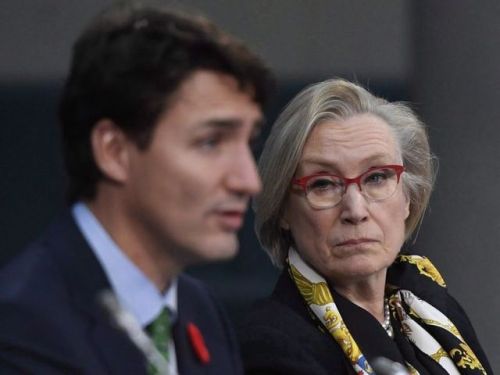
For his part, Prime Minister Justin Trudeau refused to say the word “genocide” as he addressed the assembled families, survivors and commissioners.

But those of us who have been on the wrong side of the “persistent and deliberate pattern” know that “genocide” is the right word.

As the ceremony began, it was Chief Commissioner Marion Buller who said the hard truth is that “we live in a country whose laws and institutions perpetuate violations of fundamental rights, amounting to a genocide.”

Buller, the first appointed First Nations female judge in British Columbia, took a lot of heat when the inquiry began. Members of her team were quitting, families weren’t being properly notified or compensated. Many said her mandate was overly narrow. Yet she weathered it all and fulfilled her highest purpose. She gave voice to the victims.

The inescapable conclusion of all their harrowing and beautiful testimony is that “genocide” is the only word for the state-enabled deaths of thousands of sisters, aunties, grandmothers, cousins and friends.

So why won’t our prime minister say it? What’s he afraid of?

Perhaps he understands that calling the genocide a genocide would acknowledge that his government — and others — are morally culpable for the losses of the thousands of our women, girls and 2SLGBTQQIA people. Or maybe it was the legal culpability that worried him; lawyers no doubt advised Trudeau not to say it. The pollsters, too, were probably against it, as we edge towards an election. It isn’t as easy to take a principled stand when votes are potentially at stake.

Whatever his reasons, his omission was telling. But it hardly dampened the power of the day.

“We don’t need to hear the word genocide come out of the prime minister’s mouth because families have told us their truth,” Buller said during the press conference.

The families of the taken, not forgotten women, agree. They don’t need to hear arguments over what constitutes genocide. They know it to be true because they live it.

As the ceremony drew to a close on Monday, Thunder Bay’s Maddy Murray stopped me and asked me to remember Alinda Lahteenmaki, who died in Winnipeg on Jan. 30, 2009 after plunging 11 storeys. She was 23 years old and her boyfriend pleaded guilty to manslaughter.

“There is no closure,” she said to me as the drums began to beat the warrior song.

But there can be an end to the violence.

The murders and rapes, the violence against Indigenous women and girls will continue until Canada confronts the genocide and the long-promised new relationship is finally delivered.

This requires that Canada confront the historical disadvantages, intergenerational trauma, and discrimination experienced by Indigenous people, the report explained. And that begins with making significant strides toward substantive equality through changes to our justice system, to policing, to social and health services, to education, to everything Canada prides itself on and holds dear.

To many, these institutions are a symbol of what makes Canada great. But the report makes clear that they are far from perfect. That they are rigged against Canada’s first peoples. That they are tools of colonial violence, of genocide.

That is the conclusion of Buller and her team of commissioners.

It is disappointing that many of our politicians refuse to say the word. It would be far worse — a terrible tragedy — if they continued to be complicit in the act.

Tanya Talaga is a Toronto-based columnist covering Indigenous issues. Follow her on Twitter: @tanyatalaga

New report on Tina Fontaine’s death outlines problems we keep failing to address

New report on Tina Fontaine’s death outlines problems we keep failing to address:

Five years ago, an Indigenous girl named Tina Fontaine left a downtown Winnipeg hotel and never returned. She had been placed in the hotel—alone—by the Government of Manitoba’s Child and Family Services agency as a ward of the state.

Nine days later, her ravaged body—wrapped in a duvet and weighted down by 25 pounds of rocks—was dragged out of the city’s enigmatic Red River.

She was 15 years old.

No one has ever been convicted of the murder.

Child advocate report released

This week, the Manitoba Advocate for Children and Youth released her report on the agency’s investigation into Tina’s life and brutal death.

The report lists a litany of systemic failures while the young girl repeatedly confronted treacherous circumstances. Her life story reads like a screenplay that culminates in tragic predictability.

A broken home. Her father violently murdered. Suicidal behaviour. Substance abuse. Sexual exploitation.

Throughout all of this, she encountered institutions incapable—unwilling perhaps?—of mounting a response to a child clearly in crisis.

Her last days horribly encapsulate this failure. In the 12 hours before she was last seen, she was in contact with the police, the health care system, and the child welfare system.

In the end, none of these encounters prevented her from meeting the fate that far too many Indigenous women and girls have endured in this country.

A failed system

Naturally, none of this is new. Or unusual.

In a 2013 statement, the RCMP tallied 1,181 cases of missing or murdered Indigenous women and girls. There are more now.

More broadly, report after report has fastidiously laid out the deficiencies and outright delinquencies the Canadian state has overseen and perpetrated in its dealings with Indigenous peoples.

The Royal Commission on Aboriginal Peoples, penned a quarter century ago, called for sweeping changes.

And yet, nothing.

In seeming anticipation of the apparently inevitable, Manitoba’s child advocate and author of this week’s report, Daphne Penrose, stated that “children are going to die” if changes are not made.

She’s right, of course. In the five years since Tina’s death, they have died. And they will continue to do so.

This is an awful point to make. But it is undeniable.

And it should be a reckoning. A blight on our community—our country—that cannot be overstated.

A profoundly distorted society

There are a constellation of factors which tear at the social fabric, ultimately leading to women and girls of this land ending up in shallow graves.

It is the logical and predictable evolution of the colonization process and its pernicious effects. Which results in a profoundly distorted society.

The examples abound. For instance, Indigenous people—both men and women—are between six and seven times more likely to be murdered in their lifetime in Canada.

On over 80 per cent of reserves the median income falls below the poverty line, with 25 per cent securing income that does not approximate half of the poverty line cut-off. Six in 10 Indigenous children live in poverty.

And then there is the legacy of residential schools and the attempt to systematically destroy Indigeneity. The lasting impacts are as pervasive as they are devastating.

All Canadians have a role to play in ending MMIW ‘genocide,’ report says

All Canadians have a role to play in ending MMIW ‘genocide,’ report says:

Today the Murdered and Missing Indigenous Women And Girls report was released.  

The inquiry’s final report, released publicly this morning with more than 200 recommendations to the federal government, calls violence against First Nations, Metis and Inuit women and girls a form of “genocide” and a crisis that has been “centuries in the making.”

“As the evidence demonstrates, human rights and Indigenous rights abuses and violations committed and condoned by the Canadian state represent genocide against Indigenous women, girls, and (LGBTQ and two-spirit) people,” it concludes.

And Canadian racists are arguing that it isn’t genocide.

Canada’s “Feminist” Prime Minister Justin Trudeau (Part Two)On…


Kirsty Duncan


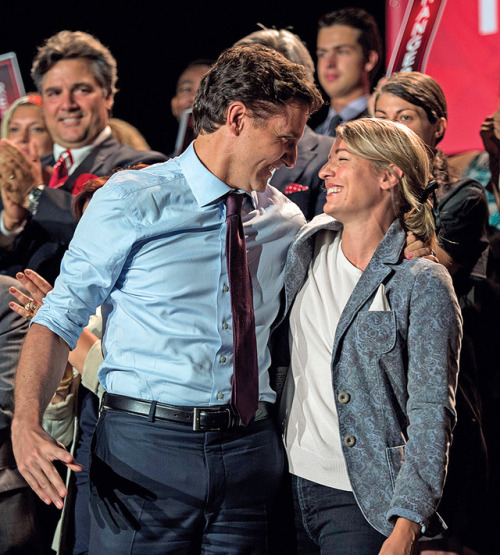
Mélanie Joly


Carla Qualtrough


Ginette C. Petitpas Taylor


Bernadette Jordan


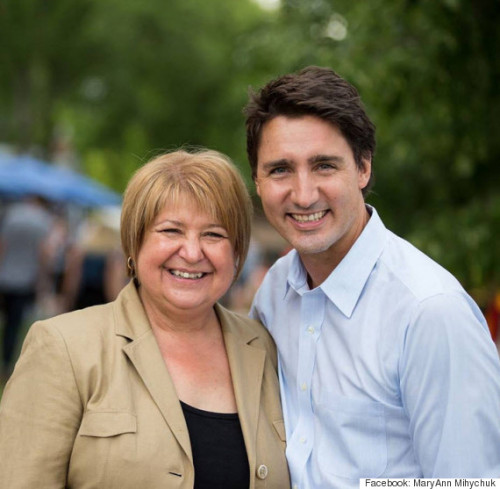
MaryAnn Mihychuk


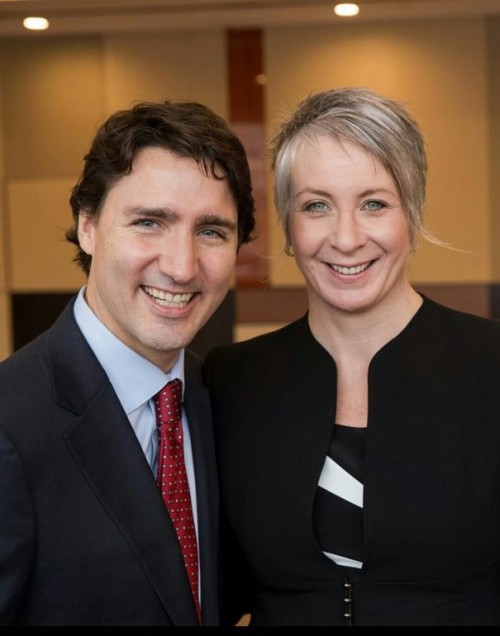
Patricia Hajdu


Filomena Tassi


Diane Lebouthillier


Carolyn Bennett

Canada’s “Feminist” Prime Minister Justin Trudeau (Part Two)

On the face of it, being in the Government’s Cabinet doesn’t just pay substantially better than being a Member of Parliament, it carries a great deal of power.  After all, it is the PM & Cabinet who decide policy and law.

Cabinet Ministers can be fired for cause — they sit at the table where policy is made, and they’re are not allowed to disagree with Government policy, ever. Even if every member of the riding that elected them begs them to vote against a law the Government is putting through, even if the Minister agrees, to vote against such a law in Parliament would lose their Cabinet post.  

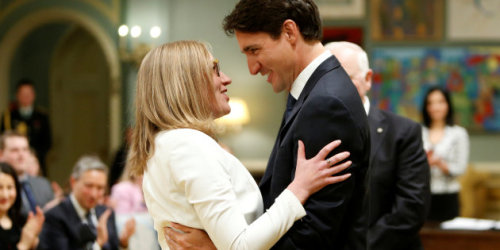
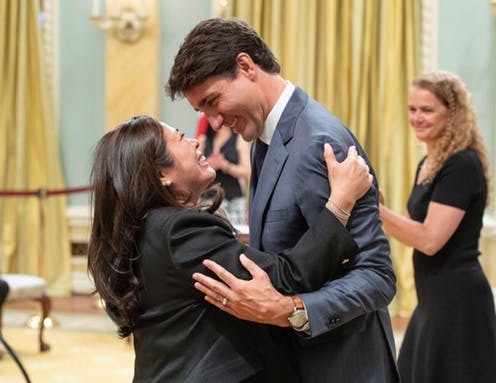
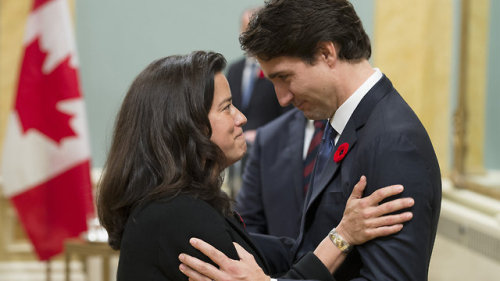
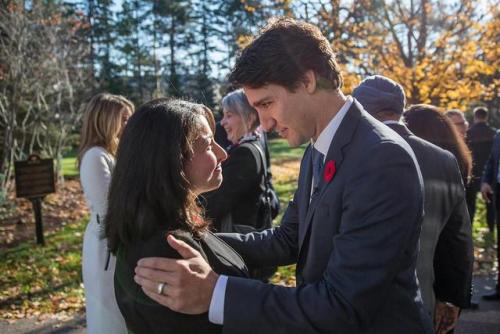
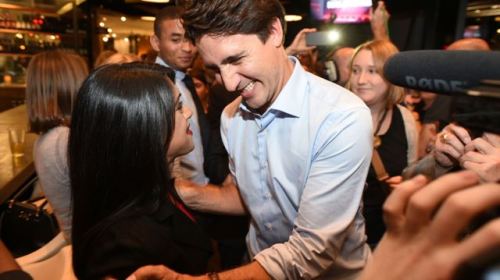
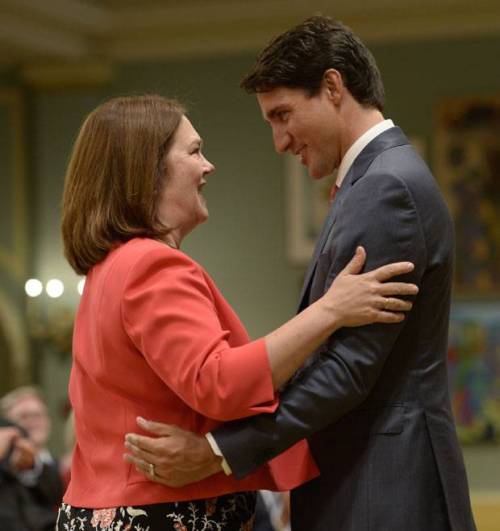
Perhaps growing up in a big family has left me with stronger than usual aversion to having personal boundaries breached.   I’ve chosen the photographs I have because I personally find most of them extremely creepy.   These photographs show the Prime Minister getting right in people’s faces.  In the nose to nose shots he’s gone way past personal distance as he gets right into people’s intimate space

In all fairness there are a few photos like this where he gets disturbingly close to men as well, so I imagine this is just his style.  Nonetheless, it is totally inappropriate in the workplace.  No employer should use his unequal power and privilege to overstep the personal boundaries of women— or men— who are effectively his employees.

      “The Prime Minister and the Ministers he or she chooses form the Cabinet. The Prime Minister also appoints Ministers of State to assist individual Cabinet Ministers. Persons appointed to the Cabinet are generally elected Members of Parliament, although it is customary for the Prime Minister to appoint at least one Senator to the Cabinet. Ministers serve “at the pleasure” of the Prime Minister, who may replace them or request their resignation at any time. The Prime Minister may also redefine ministerial portfolios and determine the size of the Cabinet as he or she sees fit.”
                                        —Executive Branch of Government in Canada

Employment law protects most people from being fired on a whim, but like a medieval monarch, Prime Minister Trudeau has the unquestioned power to fire any Cabinet Minister at any time. For any reason. Or none. 

15 of the 20 Cabinet female Cabinet Ministers are pictured in our Feminist PM’s embrace in these two posts.  

What happens to the women in Cabinet who are made uncomfortable by the imposition of such physical intimacy in the workplace?  Perhaps women MPs who mark their personal boundaries never make it into the Cabinet.  

I don’t think my definition of feminism is the same as Mr Trudeau’s.


Prime Minister Justin Trudeau is pictured above with female Cabinet Ministers: 

  • Kirsty Duncan
    Minister of Science
    November 4, 2015–July 18, 2018
    Minister of Sport and Persons with Disabilities
    January 25, 2018–July 18, 2018
    Minister of Science and Sport
    July 18, 2018 – Present
  • Mélanie Joly
    Minister of Canadian Heritage
    November 4, 2015 – July 18, 2018
    Minister of Tourism, Official Languages and La Francophonie
    July 18, 2018 – Present
  • Carla Qualtrough
    Minister of Sport and Persons with Disabilities
    November 4, 2015–August 28, 2017
    Minister of Public Services and Procurement and Accessibility[b]
    August 28, 2017 – Present
    Receiver General for Canada
    August 28, 2017 – Present
  • Ginette C. Petitpas Taylor
    Minister of Health
    August 28, 2017 – Present
  • Bernadette Jordan
    Minister of Rural Economic Development
    January 14, 2019–
  • MaryAnn Mihychuk
    Minister of Employment, Workforce and Labour
    November 4, 2015–January 10, 2017
  • Filomena Tassi
    Minister of Seniors
    July 18, 2018 – Present
  • Diane Lebouthillier 
    Minister of National Revenue
    November 4, 2015 – Present
  • Carolyn Bennett
    Minister of Crown-Indigenous Relations[a]
    November 4, 2015 – Present

    Find Part One here.

Canada’s “Feminist” Prime Minister Justin Trudeau (Part One)Even…


Karina Gould


Marie-Claude Bibeau


Mary Ng


Jody Wilson-Raybould


Catherine McKenna


Chrystia Freeland


Maryam Monsef


Bardish Chagger


Jane Philpott


Judy Foote

Canada’s “Feminist” Prime Minister Justin Trudeau (Part One)

Even though the Liberal MPs elected weren’t anywhere close to gender parity in Parliament in 2015, about a quarter of LPC MPs being women, there was a big todo made about Mr Trudeau’s choice of a cabinet that was half male & half female.  

The Prime Minister has gotten a lot of ink about his gender parity cabinet, and his insistence that he is a feminist.

Prime Minister Justin Trudeau is pictured above with female Cabinet Ministers:

  • The Honourable Karina Gould, 
    Minister of Democratic Institutions
    January 10, 2017 – Present
  • The Honourable Marie-Claude Bibeau
    Minister of International Development
    November 4, 2015 – Present
  • The Honourable Mary F.Y. Ng
    Minister of Small Business and Export Promotion
    July 18, 2018 – Present
  • The Honourable Jody Wilson-Raybould
    Minister of Justice and Attorney General of Canada
    Nov 4, 2015 – Jan 14, 2019
    Minister of Veterans Affairs
    January 14, 2019 – Present
    Associate Minister of National Defence
    January 14, 2019 – Present
  • The Honourable Catherine McKenna
    Minister of Environment and Climate Change
    November 4, 2015 – Present
  • The Honourable Chrystia Freeland
    Minister of Foreign Affairs
    January 10, 2017 – Present
  • The Honourable Maryam Monsef
    Minister of Democratic Institutions
    November 4, 2015 – January 10, 2017
    Minister of Status of Women
    January 10, 2017 – Present
  • The Honourable Bardish Chagger
    Minister of Small Business and Tourism
    November 4, 2015–July 18, 2018
    Leader of the Government in the House of Commons
    August 19, 2016 – Present
  • The Honourable Jane Philpott
    Minister of Health
    November 4, 2015 – August 28, 2017
    Minister of Indigenous Services
    August 28, 2017 – January 14, 2019
    President of the Treasury Board
    January 2019 – Present
  • The Honourable Judy Foote
    Receiver General for Canada
    November 4, 2015 – August 24, 2017
    Minister of Public Services and Procurement and Accessibility[b]
    November 4, 2015 – August 24, 2017

Canada’s “Feminist” Prime Minister Justin Trudeau (Part One)Even…


Karina Gould


Marie-Claude Bibeau


Mary Ng


Jody Wilson-Raybould


Catherine McKenna


Chrystia Freeland


Maryam Monsef


Bardish Chagger


Jane Philpott


Judy Foote

Canada’s “Feminist” Prime Minister Justin Trudeau (Part One)

Even though the Liberal MPs elected weren’t anywhere close to gender parity in Parliament in 2015, about a quarter of LPC MPs being women, there was a big todo made about Mr Trudeau’s choice of a cabinet that was half male & half female.  

The Prime Minister has gotten a lot of ink about his gender parity cabinet, and his insistence that he is a feminist.

Prime Minister Justin Trudeau is pictured above with female Cabinet Ministers:

  • The Honourable Karina Gould, 
    Minister of Democratic Institutions
    January 10, 2017 – Present
  • The Honourable Marie-Claude Bibeau
    Minister of International Development
    November 4, 2015 – Present
  • The Honourable Mary F.Y. Ng
    Minister of Small Business and Export Promotion
    July 18, 2018 – Present
  • The Honourable Jody Wilson-Raybould
    Minister of Justice and Attorney General of Canada
    Nov 4, 2015 – Jan 14, 2019
    Minister of Veterans Affairs
    January 14, 2019 – Present
    Associate Minister of National Defence
    January 14, 2019 – Present
  • The Honourable Catherine McKenna
    Minister of Environment and Climate Change
    November 4, 2015 – Present
  • The Honourable Chrystia Freeland
    Minister of Foreign Affairs
    January 10, 2017 – Present
  • The Honourable Maryam Monsef
    Minister of Democratic Institutions
    November 4, 2015 – January 10, 2017
    Minister of Status of Women
    January 10, 2017 – Present
  • The Honourable Bardish Chagger
    Minister of Small Business and Tourism
    November 4, 2015–July 18, 2018
    Leader of the Government in the House of Commons
    August 19, 2016 – Present
  • The Honourable Jane Philpott
    Minister of Health
    November 4, 2015 – August 28, 2017
    Minister of Indigenous Services
    August 28, 2017 – January 14, 2019
    President of the Treasury Board
    January 2019 – Present
  • The Honourable Judy Foote
    Receiver General for Canada
    November 4, 2015 – August 24, 2017
    Minister of Public Services and Procurement and Accessibility[b]
    November 4, 2015 – August 24, 2017

Abdoul Abdi supporters push for Nova Scotia to intervene in deportation case

Abdoul Abdi supporters push for Nova Scotia to intervene in deportation case:

allthecanadianpolitics:

Family and friends of a Somali refugee who came to Nova Scotia as a child 17 years ago were at Province House Tuesday morning trying to get the Nova Scotia government to intervene in his deportation case.

Abdoul Abdi, 23, will be in Toronto on Wednesday for an Immigration and Review Board hearing where he could be ordered deported from Canada.

“I think it’s unfair that they’re trying to strip him of his permanent resident’s card and that he can’t have health care or work, even now that he has a job,” said his sister Fatuma Abdi.. “He’s trying to better himself but the government is moving him 10 steps back.”

Continue Reading.

Canada’s record on refugees isn’t all its cracked up to be.

Collapse of U.K. construction giant Carillion puts 6,000 Canadian jobs on line

Collapse of U.K. construction giant Carillion puts 6,000 Canadian jobs on line:

Privatization: the gift that just keeps giving

@toby_sanger

Carillion purveyed billions from public sector contracts into private profits, dividends & executive bonuses. Now its failure is leaving that mess for the public sector to clean up, along with the wages and pensions of its 43,000 workers, along with 6,000 in Canada.