PEI picks Proportional Representation

back to FVC: Consultations Provide Strong Mandate for Proportional Representation #ERRE

Canadians Deserve Better -Proportional Representation - on Canadian Flag background
This is the twenty-sixth article in the Whoa!Canada: Proportional Representation Series

Electoral System with Majority Support
Mixed Member Proportional Representation
# of Votes 19,418
% of Votes 52.42
Total Valid Votes 37,040
Total number of votes required to achieve threshold 18,521

Eligible Electors 102,464

Voter Turnout 36.46%

Elections Prince Edward Island Plebiscite Results

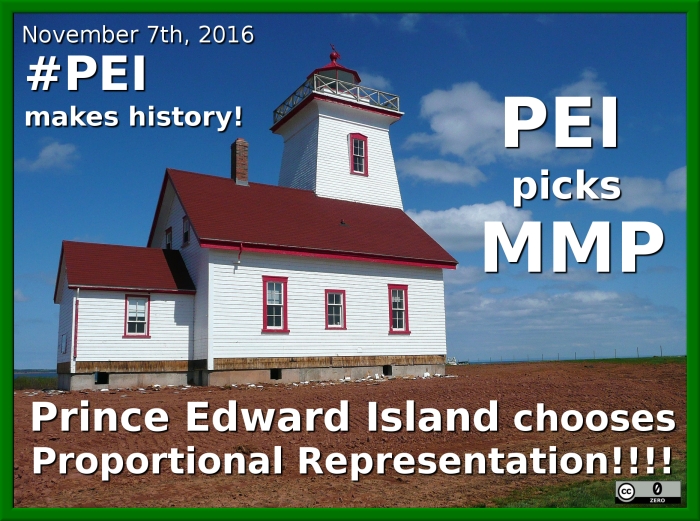
PEI picks PR (Brigitte Werner's photo dedicated to the Public Domain with CC0)

I have no doubt that good media coverage helped the process along. The PEI Guardian endorsed Dual Member Proportional, the made in Canada system proposed by Sean Graham. I was able to include Sean’s system in my Electoral System Roundup, and  I know Sean made a presentation to the federal ERRE Committee.  His system may be a real solution for the wide open spaces problem faced when looking at Federal Electoral Reform.

Unlike previous electoral reform referenda in Canada, the PEI process did a pretty good job of informing voters. If you watch the video below and those that follow, you’ll see the array of very nice explainer videos put out by Elections PEI

The tiny province of Prince Edward Island has taken the first step in leading Canada toward better democracy.  Bravo!

back to FVC: Consultations Provide Strong Mandate for Proportional Representation #ERRE

Proportional Representation Series So Far:• Proportional Representation for Canada
• What’s so bad about First Past The Post
• Democracy Primer
• Working for Democracy
• The Popular Vote
• Why Don’t We Have PR Already?
• Stability
• Why No Referendum?
• Electoral System Roundup
• When Canadians Learn about PR with CGP Grey
• Entitlement
• Proportional Representation vs. Alternative Vote
• #ERRÉ #Q Committee
• #ERRÉ #Q Meetings & Transcripts
• Take The Poll ~ #ERRÉ #Q
Proportionality #ERRÉ #Q 
• The Poll’s The Thing 
• DIY Electoral Reform Info Sessions
• What WE Can Do for ERRÉ
• #ERRÉ today and Gone Tomorrow (…er, Friday)
• Redistricting Roulette 
• #ERRÉ submission Deadline TONIGHT!
#ERRÉ Submission by Laurel L. Russwurm
• The Promise: “We will make every vote count” #ERRÉ
FVC: Consultations Provide Strong Mandate for Proportional Representation #ERRÉ
PEI picks Proportional Representation #ERRÉ

 and don’t forget to check out the PR4Canada Resources page!


Image Credit:

iconic Public Domain Prince Edward Island Lighthouse photo by Brigitte Werner has been dedicated to the Public Domain via CC0


FVC: Consultations Provide Strong Mandate for Proportional Representation #ERRE

back to The Promise: “We will make every vote count” #ERRE

Canadians Deserve Better -Proportional Representation - on Canadian Flag background
This is the twenty-fifth article in the Whoa!Canada: Proportional Representation Series

[Guest Post by Fair Vote Canada]

Fair Vote Waterloo Community Dialogues #1The all-party committee on electoral reform (ERRÉ) has just finished four months of expert and public consultations. They will make their recommendation to Government by December 1st.

Of the ERRÉ witnesses with a position on voting systems, 88% recommended Proportional Representation. This reinforces the findings from decades of research from around the world and of 13 previous electoral reform processes in Canada, including two thorough and impartial citizens assemblies.

When the Government launched the process without a mechanism for collecting empirical data, Fair Vote Canada, a multi-partisan advocacy group, started tracking the process very closely. We are releasing the results of our work to the media because we believe the process needs to be transparent and accountable.

(You can find key a list of results below with links our spreadsheets.)

Fair Vote Waterloo Community Dialogues #@Despite a strong call for proportional representation across all of the consultative platforms, we believe reforming the electoral system could be in serious trouble based on recent comments from Prime Minister Trudeau and Minister Monsef.

President Réal Lavergne expressed Fair Vote Canada’s concerns “We are worried that the Minister and the Prime Minister are saying that we cannot count on the government keeping its promise to make every vote count. Yet experts and Canadians have clearly expressed themselves in favour of proportional representation, which is what it really means to “make every vote count.”.

David Merner, Vice-President of Fair Vote Canada , 2015 LPC candidate

David Merner, Vice-President of Fair Vote Canada and former LPC candidate (2015)

David Merner, Vice-President of Fair Vote Canada and a Liberal candidate in last year’s federal election adds “This is not the time for back-tracking. The Prime Minister and the Minister of Democratic Institutions have personally created a sense of hope in Canadians, building on the 2015 Liberal campaign promise of Real Change. Millions of voters believed that the government intended to keep its promises. We believed the political cynicism of the Harper years was behind us, and thousands of us participated in the government’s consultations in good faith.”

Merner says “Now is the time for the government to deliver on its promises.

Fair Vote Waterloo Community Dialogue ERRÉ in CambridgeHighly regarded Conservative strategist and spokesperson for the Every Voter Counts Alliance, Guy Giorno, adds that “committee members must endorse what’s right for Canadians, not what benefits any particular party. Given the weight of the evidence before the committee, the only legitimate option is a recommendation for proportional representation. Let’s also remember that electoral reform was a major issue at the last election, and voters overwhelmingly supported parties promising change.”

The weight of expert testimony in favour of PR was echoed across the country in hundreds of town halls and public dialogues.

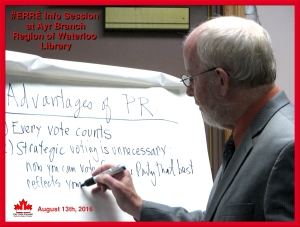
ERRE Info Session at Ayr Branch Library

Over the next few days the ERRÉ will negotiate a recommendation for a new electoral system for Canada. The final report is due on December 1.

Fair Vote Canada’s President Réal Lavergne explains that “Once that recommendation has been made, it will be incumbent on the minister to carry it forward and for the government to act on it. Leadership will be required to educate both the public and parliamentarians, and to champion the proposed reform.”

“Based on all the results of the expert and citizen consultations, the committee’s only legitimate option is to recommend in favour of proportional representation.”

Key indicators from ERRÉ hearings

Canadian Electoral System expert Dennis Pilon testified before the ERRE Committee.

Canadian Electoral System expert Dennis Pilon testified before the ERRE Committee.

88% of expert witnesses who expressed a preference called for proportional representation

4% supported the Alternative Vote
(majoritarian ranked ballot systems tend to evolve towards a two-party system, often favour centrist parties and could further entrench the distortions brought about by our existing majoritarian system. )

67% thought a referendum was undesirable or unnecessary.

Detailed analysis can be found here in our Synthesis of witness statements and views.

Open Mic-sessions

From coast to coast, Canadians lined up at the ERRÉ open-mic sessions asking that the committee keep the promise and deliver PR.

According to data released this week by the NDP, out of 428 participants who spoke up, 374 (87.38%) called for proportional representation.

MP town halls

PR in the Back YardTotal number of town halls reporting: 174

The following indicates the level of support observed for proportional representation in MP town halls.

69.5% (121 town halls) – Majority of speakers calling for proportional representation.

8.6%% (15 town halls) – Majority for electoral reform, but no clear majority specifically for proportional representation

Brantford-Brant Community Dialogue

5.2%  (9 town halls) – Support divided between majoritarian system and proportional representation

5.7%   (10 town halls) – Majority for the status quo

8.0% (14 town halls) – Report does not allow any majority view to be identified

2.9%   (5 town halls) – Majority support for the Alternative Vote

Detailed analysis can be found here in our
Synthesis of witness statements and views.

New Hamburg Branch info sessions

Citizen Community Dialogues & EventsWaterloo Region Greens Community Dialogue

Here are basic indicators from the 27 dialogues or town halls hosted by citizens and community groups posted on the ERRÉ site or for which we have directly obtained the information so far:

Total number of participants: 1,058

88% (22 events) – A majority of speakers calling for proportional representation

8% (2 events ) – A majority for change but no majority for any one option

12% (3 events) – Report does not allow any majority view to be identified.

We are aware of at least 15-20 other community dialogues that are not yet posted on the ERRÉ site.

Detailed analysis can be found here.

Minister Monsef’s Townhalls

Minister Monsef organized two types of town hall consultations: ones in her own riding, and others as part of a cross-country tour. Here is an extract from the report submitted to the ERRÉ on town halls held by Minister Monsef in her Riding of Peterborough:

“It is clear that there is an appetite for thoughtful change to the electoral system. While opinions on the various electoral systems did vary, most participants indicated their support for a more proportional electoral process that still respected the need for local representation and simplicity of the ballot.”

Although Minister Monsef routinely conducted straw polls on issues such as mandatory voting and online voting in town halls on the road, she did not do the same regarding support for proportional representation. FVC volunteers attended these events across the country and shared their opinions. Here are a few quotes from participants:

Toronto:
 “PR was clearly the main issue for most. With respect to PR, many attendees spoke passionately and eloquently in favour, and if anyone present opposed it, he or she was not bold enough to express that view.”

Vancouver: “It seemed that 90% of the audience… did want some form of PR.”

Edmonton: “ It seemed most people were in support of some sort of proportional representation.”

Yellowknife: “She asked whether the participants liked FPTP to remain, or Ranked system or STV or MMP or Proportional Representation implemented. One voted for FPTP. Many voted for MMP and a few voted for PR.”

Yukon: “Some Yukoners came in support of our current electoral system (First Past the Post); more were on the side of moving towards proportional representation.”

Halifax: “The feedback from the groups certainly favoured PR.”

Montreal: “There was an overwhelming support for PR in the room.”

Thunder Bay: “Of the dozens who rose to spoke, everyone spoke in favour of PR.”

Gatineau: “ Participants spoke to PR at every opportunity they had… However, the format made this difficult… Taking into consideration those interventions that spoke to the issue of PR vs FPTP or AV, the overwhelming majority of interventions – in the order of 70% or more – were in favour of PR.”

Waterloo: From the report of 4 MPs: “Every group discussed the need for our new electoral system to feature some degree of proportionality.”

Charlottetown: “ About 90% of the people there were pro-PR.”

Winnipeg: After noting that three people were for FPTP because they feared losing local representation. The rest of the comments I heard were mostly just preferences for the different PR systems.”

Happy Valley-Goose Bay: “What we said was that we wanted PR  BUT, it had to be a hybrid type that considered the lack of population and massive land mass of not only Labrador but 60 % of Canada, i.e. the North.”

Calgary: “There was overwhelming support for getting rid of the current system, with different groups mentioning STV or MMP as their top choice.”

The Hon. Maryam Monsef addresses the crowd in Waterloo Region.A concluding note

And, to conclude, this eloquent quote from a Fair Vote Canada volunteer at the Victoria town hall where the Minister said she “can’t promise you that I’ll be advocating for PR because I haven’t heard that from an overwhelming majority across the country.“

Victoria:

“The wheels were skidding out of control as we tried to combat the spin we received at last night’s town hall on Electoral Reform. Maryam Monsef, the Minister of Democratic Institutions hosted the gathering in Victoria billed as “the last chance” to give your input. But the tone of the meeting was quite acrimonious. They were clearly managing the message while backpedaling from an election commitment about changing the electoral system. Not only did she defend Trudeau’s recent comments about no longer needing this reform because we voted for HIM.”

“After months of hearing expert witness by the proportionally cross-partisan panel, and while MPs held public consultations with thousands of Canadians across the country, are we now to believe there is no appetite for Proportional Representation? Monsef said that she has not yet made up her mind but the implication of her words was troubling. Will the government diminish the committee’s well-researched, democratic report in December by championing their predetermined preference? For many of us who attended last night the so-called consultation felt like a sham.”


PS from Laurel:

I’ve chosen to used my own photographs, here, not only because they are free culture photos (licensed to share under a Creative Commons Attribution 3.0 Unported License) but because the number of electoral reform events in and around Waterloo Region has been staggering, and I wanted to share some of them with you, but there were so many local ERRÉ events that I attended (and I didn’t attend them all)  that there isn’t enough room here to use photos from them all!

There was a time not long ago when I knew nothing about electoral reform.  It was only when I was asked to take photos at local Fair Vote Waterloo events that I found myself listening to what the Fair Vote folks had to say, and after a while I even started understanding it.   This was not an easy process, nor was it fast.  It can take a while to really gain an understanding of something completely different from what we’re used to.  

That’s why every electoral reform event must incorporate an education piece.  The thing that I have seen over and over again is that even though Canadians may not know the words for it, or how to fix it, we know something is wrong with our voting system that needs to be fixed.

That is why Mr. Trudeau’s “We will make every vote count” resonated with so many people.  

And what I have learned from every discussion and every ERRÉ event I’ve attended is that when Canadians have a chance to understand the difference between winner-take-all and Proportional Representation, we almost always want some form of PR.    I think that’s because most Canadians value fairness, and the only way to get to a point where the votes of most Canadians actually count will require some form of Proportional Representation.  

Fair Vote Canada suggests Canadians who want to see the implementation of some form of Proportional Representation would do well to let the ERRÉ Committee know about it, and to make it easier for us, they have an automated tool to help us send a letter urging the committee to recommend PR here:

http://fairvotecanada.good.do/thankyou/keepthepromise

back to #The Promise: “We will make every vote count” #ERRE

Proportional Representation Series So Far:• Proportional Representation for Canada
• What’s so bad about First Past The Post
• Democracy Primer
• Working for Democracy
• The Popular Vote
• Why Don’t We Have PR Already?
• Stability
• Why No Referendum?
• Electoral System Roundup
• When Canadians Learn about PR with CGP Grey
• Entitlement
• Proportional Representation vs. Alternative Vote
• #ERRÉ #Q Committee
• #ERRÉ #Q Meetings & Transcripts
• Take The Poll ~ #ERRÉ #Q
Proportionality #ERRÉ #Q 
• The Poll’s The Thing 
• DIY Electoral Reform Info Sessions
• What WE Can Do for ERRÉ
• #ERRÉ today and Gone Tomorrow (…er, Friday) 
• Redistricting Roulette 
• #ERRÉ submission Deadline TONIGHT!
#ERRÉ Submission by Laurel L. Russwurm
• The Promise: “We will make every vote count” #ERRÉ
FVC: Consultations Provide Strong Mandate for Proportional Representation #ERRÉ

 and don’t forget to check out the PR4Canada Resources page!


An Enemy of The PeopleNovember 10 – 12, 20168:00 pmChrist…


An Enemy of The People

November 10 - 12, 2016
8:00 pm

Christ Lutheran Church
445 Anndale Road, Waterloo


Local Play about Blowing the Whistle on a Water-Safety Crisis

Many of us remember incidents of severe water contamination in Grassy Narrows, Walkerton, Elmira, Ontario, and in Flint, Michigan. Do you also remember how some municipal and provincial or state authorities and local businesspersons tried to cover up the dangers to residents’ health? That’s what the next theatre production by Christ Church Waterloo is all about: environmental and moral responsibility.

On November 10th-12th @ 8 pm Christ Players presents in the sanctuary Richard Walsh’s adaptation of Henrik Ibsen’s original 1882 drama, An Enemy of the People

Richard has set the play in Canada 2016, abbreviated it, modernized the language, and incorporated audience participation. As well, after each performance audience members can participate in group discussion about the issues the play raises.

In the play the main character, “Dr. Thomas Stockmann,” who is his town’s Medical Officer of Health, discovers that the source of water for the town and its new healing baths is dangerous to use. He sets out to overcome cowardice and deception by the powers-that-be in the face of this crisis in public health. Despite his political naiveté, Thomas bravely challenges the town’s status quo for what he believes is the greater good. However, like all the characters in the play, he has personal flaws that make his attempts to resolve the dangers to his community difficult to achieve.

Tickets ($15 for adults, $10 for students) may be ordered in advance from the church office @ 519-885-4050.

Seating, which is general admission, is limited to 100 per performance. 

(As this production contains some coarse language, it’s suitable for students from Grade 7 onwards.) All proceeds will be directed to the church’s community-outreach programmes.

STOP #CETA: Lessons from Canada

Canadians are not clamouring for CETA.  My fingers are crossed; I’m one nice patient Canadian who hopes Belgium will hold fast and continue to refuse to sign the CETA (Comprehensive Economic and Trade Agreement).

I really don’t get why our Government is pursuing this Trade Agreement sought by the Harper Conservative Government.  Because the fact is, Canada has indeed suffered from “free trade” agreements, as pointed out in the Council of Canadians video below. I cannot comprehend why Canadian Governments are so willing to sign these things. Investor State Dispute Settlements are not good for democracy.

The Economist says:

IF YOU wanted to convince the public that international trade agreements are a way to let multinational companies get rich at the expense of ordinary people, this is what you would do: give foreign firms a special right to apply to a secretive tribunal of highly paid corporate lawyers for compensation whenever a government passes a law to, say, discourage smoking, protect the environment or prevent a nuclear catastrophe. Yet that is precisely what thousands of trade and investment treaties over the past half century have done, through a process known as “investor-state dispute settlement”, or ISDS.

— The Economist Investor-state dispute settlement: The arbitration game

There is a lot more information about why CETA as it stands in a letter written by a group of Canadian academics”

AN OPEN LETTER TO THE PARLIAMENT OF WALLONIA AND BELGIAN VOTERS ON THE PROPOSED CETA AND ITS FOREIGN INVESTOR PROTECTION SYSTEM

“To the Parliament of Wallonia and Belgian voters:

“We are Canadian academics with extensive collective expertise in investor-state dispute settlement (ISDS) and related issues under Canada’s trade and investment agreements. We are also among a small group of Canadian experts in this field who do not work in law firms or government as ISDS lawyers/ arbitrators.

img_5503“We write after reading news reports this past weekend about the scare tactics employed by Canadian politicians and business representatives in an effort to influence your legislative and government processes. We do not think that these voices represent accurately Canada’s experience under the foreign investor protection system that the CETA would expand. We are aware that many Canadians have expressed deep concern about this foreign investor protection system due to Canada’s experience with a similar system under the North American Free Trade Agreement (NAFTA) and in debates about the Canada-China Foreign Investment Promotion and Protection Agreement (FIPA), among other agreements.

“While we focus here on adverse consequences of the foreign investor protections in the CETA, we are also aware that the agreement will impose new constraints in many other areas of public policy beyond what we discuss. They include but are not limited to pharmaceutical regulation, public health, agriculture, government procurement, public services, labour rights, and market access. We note that other academics have raised significant concerns about the CETA in these areas.

“Since the NAFTA came into effect in 1994, Canada has been and remains the only Western developed country that has agreed to ISDS on a comprehensive basis while in the more vulnerable capital-importing position. In the case of NAFTA, Canada agreed to ISDS on this basis with the U.S. and Canada has since faced more foreign investor claims than all but a handful of countries, has paid compensation in response to numerous claims, and has altered government decisions or decision-making processes in order to accommodate foreign investor interests and to reduce risks of potentially massive liability.

“Business spokespersons who have defended these concessions of Canadian democracy and sovereignty often represent foreign companies in Canada or Canadian companies that may own companies abroad and be interested in bringing claims against Canada. It is perhaps understandable, though still very regrettable, that large businesses are keen to acquire special rights and special access to public money through ISDS.

“Reforms to ISDS in the CETA, relied on by Canadian officials to describe the CETA misleadingly as “progressive”, are inadequate to address major concerns about the CETA. The major concerns
include the undermining of democratic regulation, the special privileging of foreign investors, the lack of judicial independence and procedural fairness in the adjudicative process, and the lack of respect for domestic courts and domestic institutions. In particular, the “Investment Court System” (ICS) in the CETA does not remove the financial threat posed by foreign investor claims to democratic regulation, does not alter the unjustified and gross favouring of foreign investors over anyone else who has a conflicting right or interest, and does not establish a proper court with the usual safeguards of independence and fairness.

“These problems with the CETA’s foreign investor protections remain outstanding, despite the recent Joint Interpretive Declaration issued by Canada and the EU (in all of the various forms in which that Declaration became public).

“We are heartened that your democratic processes in Wallonia have allowed for close and careful consideration of the CETA’s flaws as part of a genuine and thoughtful debate. We wish Canadians had been permitted to have a similar debate based on a vote in Canada’s Parliament and provincial legislatures, but that has not been the case under the Harper government or the Trudeau government. In contrast to the views expressed undiplomatically by some Canadian politicians and business representatives, it appears to us that Belgian democracy has been exercised responsibly, as it should be, to allow parliamentary votes on the quasi-constitutional structures created by foreign investor protection agreements like the CETA.

“In Canada, our democracy has suffered because the federal government has insisted on pushing through agreements like the NAFTA and the CETA without legislative votes at the federal and provincial levels. As a result, and without the corresponding endorsements by our elected representatives, we have been left with a foreign investor protection system that binds all levels of government and that will bind all future elected governments in Canada for a very long time. Our experience hints at the dangers faced by European democracy in the case of the CETA. Whatever decisions you take, we urge you not to succumb to the same types of tactics used to mislead and scare Canadians into undermining our democracy on behalf of foreign investors. Canada and the European Commission have been aware for years that the CETA faced significant public and academic opposition due to its foreign investor protections. Yet they declined to remove these non-trade elements from the CETA.

“In a context where there is no credible justification for including ISDS or ICS in the CETA – given the greater reliability, independence, and fairness of Canadian and European democratic and judicial processes – it still surprises us how big business groups and governments acting on their behalf ferociously cling to such a deeply flawed and undemocratic model. In case they are of interest, we have noted below a few additional documents indicating concerns with the foreign investor protection system. We have also listed a larger sample of relevant publications by the signatories.

“From what we can see, you have shown great courage in opposing the CETA and, based on our observations of how the foreign investor protection system has been pushed on Canadians over the years, we wish to express our support for your democratic choices.”

The original letter including the complete list of signatories and links to supporting documents can be found On the European side you need look no further than the FFII blog, whose most recent article is, “A deceitful attempt to get CETA signed”

If all of this is too highbrow to grasp in one sitting, check out BUZZ FEED: The Court That Rules The World

The point is really that CETA is a bad deal for citizens on both sides of the pond.

Michael Geist has been talking about (and highlighting the flaws in) “trade deals” like CETA for years, so I’ll leave the last word to him: CETA Failure Reflects Public Rejection of Sweeping Trade Deals: Don’t blame EU unreasonableness for saying no to bad agreement with Canada.


Anti Racism Directorate Pubic Forum Today ~ October 24th,…


Anti Racism Directorate Pubic Forum

Today ~ October 24th, 2016

7pm — 10pm 
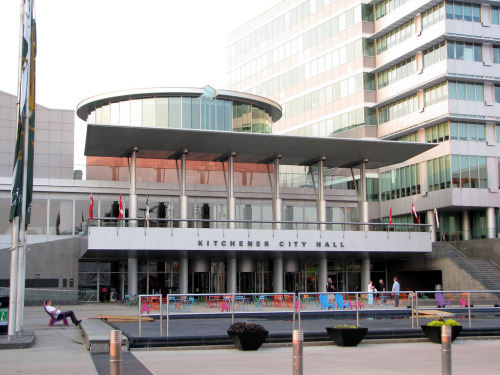
at Kitchener City Hall  

Re: Minorities & First Nation’s

The Anti-Racism Directorate was created in February 2016 and works to address and prevent systemic racism in government policy, legislation, programs and services.

Have your say: public community meetings

We want to learn and hear from you. We’re hosting community meetings across the province to hear your ideas on addressing systemic racism.

The meetings are also a chance to learn more about what we do. Everyone is welcome to attend.

The Promise: “We will make every vote count” #ERRE

back to #ERRE Submission by Laurel L. Russwurm

Canadians Deserve Better -Proportional Representation - on Canadian Flag background
This is the twenty-fourth article in the Whoa!Canada: Proportional Representation Series

On the 1st anniversary of the Liberal Majority, Prime Minister Justin Trudeau suggests Canadians have lost our “appetite” for electoral reform now that his party has won a majority government.

A majority built on 39% of the votes cast.
Just as Mr. Harper had a majority built on 39% of the votes cast.

Our Electoral System Is Changing

Something unprecedented happened in the 42nd Canadian federal election of 2015.  Every party — except the one in power — campaigned on electoral reform.  This is something that would never happen without wide spread dissatisfaction with the electoral system we use now.

When most people feel they can’t vote for what they want, even if the person they vote for is elected, they don’t have the representation in Parliament they want.  When the system fails to serve us, we don’t feel engaged in or satisfied by the process.  When a majority of voters are routinely unrepresented, when some votes count more than others, but most votes don’t count at all, there is something wrong with an electoral system.

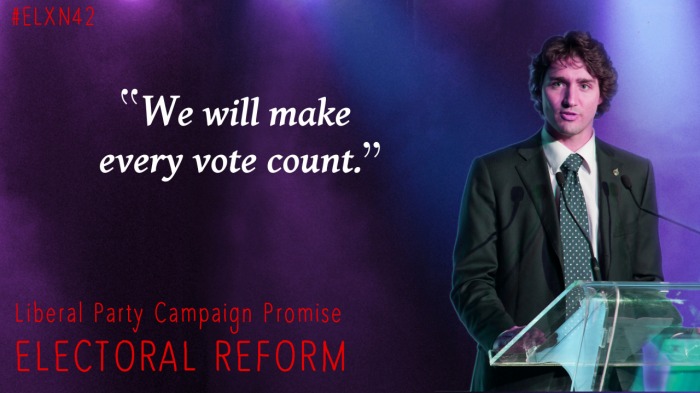
Even though we don’t understand the problem or know how to fix it, we know something isn’t working.  So when Mr. Trudeau said, “We will make every vote count,” it resonated with Canadians.

Justin Trudeau's Election Promise: "We will make every vote count."

erre-r-here-nuThe Liberal Party promise was itself an acknowledgement of the uncomfortable truth that every vote does not count in the voting system Canadians use now.

So it shouldn’t come as a surprise that a lot of Canadians were less than pleased to read the ipolitics report:  Trudeau taking heat for walking back electoral reform: Prime Minister tells Le Devoir Canadians’ motivation for change has weakened.

Our votes need to count as much today as they did last October.

The electoral reform process has barely begun.  Although the public consultation is over, the ERRE Committee hasn’t even finished hearing experts.

Your vote should count.  And so should mine.  All of our voices deserve to be heard, but they won’t be until we have a fair electoral system.  Canadians have been waiting for meaningful electoral reform for a hundred and fifty years. We can’t let them walk away from this election promise, this is our historic opportunity to create a stronger democracy and public policy that serves all Canadians.

Please phone or email your MP to let them know that we expect them to keep their election promise to make every vote count.

Tell your MP that backing off on electoral reform will lose your vote.

Here are the phone numbers and email addresses of our Waterloo Region Liberal MPs.

Bryan May – Cambridge
telephone: 519 624 7440
email: Bryan.May.P9@parl.gc.ca

MP Bryan May and the Honourable Maryam Monsef

Marwan Tabbara – Kitchener- South Hespeler
telephone: 519 571 5509
email: Marwan.Tabbara.P9@parl.gc.ca

The Honourable Maryam Monsef, MP Raj Saini and MP Marwan Tabarra

Bardish Chagger – Waterloo
telephone: 519 746 1573
email: Bardish.Chagger.P9@parl.gc.ca

The Honourable Maryam Monsef and the Honourable Bardish Chagger

Raj Saini – Kitchener Centre
telephone: 519 741 2001
email: Raj.Saini.P9@parl.gc.ca

Read the article in Le Devoir
or the English Translation

If you aren’t in Waterloo Region, you should contact your Liberal MP too.  And if you don’t know who your MP is, you can find out here by Postal Code.  If you know who it is but need the contact info you can find it here by typing your MP’s name.

And no matter where you live, you can sign the Broadbent Institute’s
Petition: Justin Trudeau, keep your promise to bring in electoral reform


Image Credits:
Justin Trudeau by A.k.fung has been dedicated to the Public Domain, which made it possible for me to dedicate my mini-poster  to the Public Domain as well.

back to #ERRE Submission by Laurel L. Russwurm

Proportional Representation Series So Far:• Proportional Representation for Canada
• What’s so bad about First Past The Post
• Democracy Primer
• Working for Democracy
• The Popular Vote
• Why Don’t We Have PR Already?
• Stability
• Why No Referendum?
• Electoral System Roundup
• When Canadians Learn about PR with CGP Grey
• Entitlement
• Proportional Representation vs. Alternative Vote
• #ERRE #Q Committee
• #ERRE #Q Meetings & Transcripts
• Take The Poll ~ #ERRE #Q
Proportionality #ERRE #Q 
• The Poll’s The Thing 
• DIY Electoral Reform Info Sessions
• What WE Can Do for ERRE
• #ERRE today and Gone Tomorrow (…er, Friday) 
• Redistricting Roulette 
• #ERRE submission Deadline TONIGHT!
#ERRE Submission by Laurel L. Russwurm
• The Promise: “We will make every vote count” #ERRE

 and don’t forget to check out the PR4Canada Resources page!


#ERRE Submission by John Filliter

canadians-have-their-say

Submission to ERRE, the House of Commons Special Committee on Electoral Reform
by John Filliter, Private Citizen
Friday, October 7th, 2016
at Fredericton, New Brunswick

The following are my views alone. They generally should be regarded as arguments and opinions rather than assertions of fact.

To review a bit of legal context, political theory and the history of Canada’s electoral system:

Sections 40 and 41 of the Constitution Act, 1867 both begin “until the Parliament of Canada otherwise provides”. Section 40 deals with division of the original provinces joining Confederation into Electoral Districts. In the past, there were some multi-member ridings, for example. Section 41 continued existing election laws in the four provinces, including qualifications and disqualifications of candidates and voters, and proceedings at elections. The suffrage has been extended to include women, for instance. So it appears that Parliament (i.e., the Governor General, the Senate and the House of Commons under Section 17 of the Act) has the authority to reform proceedings at elections, etc. This is likely to be subject to court challenges, of course.

One provision which might prove problematic is Section 52, which states that Parliament may increase the number of MPs as long as this does not disturb the proportionate representation of provinces prescribed by the Act.

Section 1 of the Canadian Charter of Rights and Freedoms guarantees the rights and freedoms set out in it “subject only to such reasonable limits prescribed by law as can be demonstrably justified in a free and democratic society”.

Section 3 of the Charter describes the first of our Democratic Rights to be the right of every citizen of Canada to vote in an election of members of the House of Commons … . Section 15(1) of the Charter provides that every individual is equal before and under the law and has the right to the equal protection and equal benefit of the law without discrimination
(My italics)

Equal benefit of the right to vote implies that the votes of all Canadians should carry equal weight, subject to Section 51A guaranteeing all provinces at least as many MPs as they have Senators.

One glaring problem that can be seen in the 2015 election results is the share of seats that was generated by the number of votes cast for parties, namely:
Liberals - 6,930,136 Votes - 39.466% 184 54.43% Conservatives - 5,600,496 Votes - 31.894% - 99 seats - 29.28% New Democrats 3,461,262 Votes - 19.711% - 44 seats -13.01% Bloc Quebecois 818,652 - Votes - 4.662% - 10 seats - 2.95% Green Party 605,864 Votes - 3.450% - 1 seat - .29%

First Past the Post (FPTP) clearly did not translate votes into seats accurately; rather it produced a False Majority.

When Canada inherited FPTP from Great Britain in 1867, it worked reasonably well because there were only two significant parties at the time. Before 1921, there were 13 Majorities, 11 True and 2 False. (A “true” majority means one where the victorious party won over 50% of the votes.)

In 1896, Wilfrid Laurier’s Liberals won a majority of 118 seats with only 45.1% of the popular vote compared with Charles Tupper’s Conservatives and Liberal/Conservatives who took 46.3%. Tupper won 416,640 votes to Laurier’s 405,506! This was our first federal election “stolen by the system”.

Since 1921, Canada has had a Multi-Party System featuring at least three substantial parties contesting each election. During that 95-year period, we have elected 18 Majorities (4 True, 14 False) and 11 Minorities, and 4 more elections were stolen by the system (1926, 1957, 1962 and 1979). The only True Majorities since 1921 have been in 1940, 1949, 1958 and 1984.

FPTP has produced some other serious distortions of the votes of Canadians. Consider 1993, for example, when Jean Chretien won 177 seats with 41.32% of the vote. The Bloc Quebecois formed the Official Opposition with 54 seats, but only 13.50% of the vote. The Reform Party came third with 52 seats based on 18.72% of the vote. The NDP won 9 seats with 6.87% and the PCs were last with only 2 seats but 15.99% of the popular vote!

The 1993 results demonstrate the danger of regional divisions that can be caused by FPTP, not to mention the undermining of national unity. It is not healthy for democracy to have parties shut out of provincial or regional seats because of FPTP.

Democracy is defined as “a system of government by the whole population, usually through elected representatives”. The first Canadian colony to be granted Representative Government was Nova Scotia in 1758, though in reality the ‘family compact’ continued to govern for another 90 years. In 1848 Nova Scotia became the first province to be granted Responsible Government.

What is the role of an electoral system? It should translate the votes cast across the country into seats that reflect the proportion of votes each party received, not distort the election results to produce a majority government. If the people vote for a minority government, that is what the system should give them. The current system is a broken one that has been antiquated for 95 years. It needs to be replaced. Now. FPTP often does not truly represent how the people voted. This is neither democratic nor fair.

Is there any way of correcting this problem?

There are basically two types of electoral systems – Majoritarian and Proportional Representation (PR) ones – plus combinations of the two.

Majoritarian Systems are winner-take-all systems designed to come up with a winner by fabricating a majority, if possible; they do not support majority rule per se, rather assist a party to attain a majority by such gimmicks as having seats solely determined at the local level, dropping candidates off the ballot and redistributing their votes, holding run-off elections, etc.

PR systems are designed to allocate seats to the parties based on their share of the votes cast in a general election.

Canada must adopt some form of PR if we are to enjoy real democracy in the one elected arm of Parliament.

There are many forms of PR systems in use around the world – a majority of democratic countries and over 80% of OECD countries use some form of PR, including Germany, Sweden, Scotland, Ireland, Australia and New Zealand, most European and Latin American countries. Canada is one of only three major developed democracies that don’t use it.

This Committee is best qualified to choose the form and features of PR that would be most appropriate for Canada, which faces some unique geographical and demographic challenges.

My preferences include a Mixed Member Proportional system with:

(a) provinces divided into Regional seat groupings comprised of up to 12 or so existing seats; a province with 12 or fewer seats would comprise one Region;

(b) these seats being divided into Local MPs and Regional MPs almost equally;

(c) electors voting for a Local MP, party and/or up to the maximum number of Regional MPs to be elected;

(d) voting by Open List ballots under which electors could split their Regional MP votes among candidates from different parties if they wish, or simply vote for an entire “party ticket”;

(e) parties being awarded Regional MPs based on their share of the provincial popular vote, to the extent of under-representation in seats won by Local MPs;

(f) a party’s candidate(s) who received the highest number of votes but weren’t elected as Local MPs becoming its Regional MP(s);

(g) if after provincial PR was calculated, there remained some national dis-proportionate representation, parties still under-represented in seats would be awarded Nationally Guaranteed Seats provided that they garnered at least 4% of the valid votes cast nationally and they contested at least 95% of the ridings.

(h) Under-represented parties that qualify should be entitled to 3.38 seats for every full percentage point of the national vote that they win, minus any partial seat and any Elected MPs. They would have to select their MPs for Nationally Guaranteed Seats in a manner that would maintain proportional representation of provinces.

(i) candidates would continue to be elected by a plurality: plurality winners are as legitimate as those who might pass them as preferred second or third choice candidates.

(j) If the Committee or the House takes the view that Local MPs should be elected by a majority rather than a plurality, ranked or preferential ballots should be used. (Run-off systems take too long and cost too much.) However, rather than counting only second choice ballots of the lowest candidate, all ballots should be considered when second (third, fourth) choices are counted. Why should second choices of only voters who supported the least popular candidate be counted? Every ballot should be treated equally. Moreover, when second and succeeding choices are counted, they should be weighted by dividing by the number of the round. (Second choice ballots by 2, third by 3, and so on.) The original number for a majority should be maintained. (The same logic would apply if Single Transferable Vote were adopted: all second choice votes of a candidate who attains the quota should be counted, not just the votes remaining when the quota is achieved.)

(k) The ballot should give voters an option to vote for “None of the above candidates”, especially if mandatory voting is adopted. Voting is supposed to be secret and in our last provincial election, some voters were asked whether they intended to spoil their ballots when the voting machines indicated that they hadn’t voted for anybody.

To address the Guiding Principles that the House of Commons has identified for consideration:

PR would restore the Effectiveness and Legitimacy of voting because the system respects and reflects how electors actually voted. It would reduce the distortions between the percentage of popular vote a party receives and its share of the seats. The electoral result would closely mirror voter intention and should bolster public confidence in the system.

PR would promote greater Engagement and Participation in the democratic process because electors would see that their votes had a much greater chance of being effectual in electing MPs or party. Under-represented groups would be encouraged to participate in the process if they believed this would give them some influence. This would probably reduce some of the apathy, cynicism and alienation that results from a system which distorts how citizens voted. Studies have shown that PR tends to increase voter turn-out by 7 to 8%, improve civility and collaboration among opposing politicians, and reduce regional divisions.

Accessibility and Inclusiveness of all eligible voters: under PR a greater diversity of views and minority groups are usually represented. There should be simultaneous initiatives to make voting easier for electors who face accessibility challenges of any kind, including physical, visual, intellectual and regulatory ones. Elections Canada should work with ethnic groups across the country to produce videos explaining how to vote in every language and dialect, and these should be available online. Civics courses and kits should be provided by the government. Documentation requirements to establish identity and residence should be relaxed and optional Canadian Voting Cards considered. The more citizens participate, the stronger our democracy is.

Online and Electronic Voting may make voting easier and more accessible but I have serious reservations about them. This may be because of my ignor-ance of modern technology but I wouldn’t entrust elections to it. I have con-cerns that foreign hackers could alter the outcome of our elections and we might not even realize it. If foreign hackers can get into the databases of some of our largest government departments, how can the security of our elections be guaranteed? Within the last two months Australia’s online voting plan was derailed by a DDOS attack. A computer programmer testified before a U.S. Congressional Committee that he had coded computers to rig elections. There are also issues about establishing the identity of who cast a vote online, or whether undue influence was exercised over a voter, or a vote was “sold”.

Most importantly, just as justice must be seen to be done, so too ballots need to be seen by scrutineers of the parties to verify that they aren’t spoiled, fake, awarded to the wrong candidates, or counted incorrectly. In short, these proposed innovations are at best premature.

With regard to Mandatory Voting: forcing citizens to vote against their will is a bad idea. Some may object for religious reasons; some may not feel informed enough on the issues or candidates; some may face serious access-ibility, time, literacy or financial challenges. Those who do vote under duress may just vote for the first candidate(s) on the list, which could skewer results.

Lowering the Voting Age to 16 might lead to higher voting by a younger cohort in the future, especially if accompanied by classroom civics training on how to vote and discussion of issues. However, lowering the voting age in the past did not lead to a spike in voter turn-out.

With regard to avoiding undue complexity in the voting process, while PR presents voters with more choices, I don’t think it involves “undue complexity”. Choosing a party in addition to a Local MP candidate is hardly a daunting task; in fact, many if not most MPs are probably already elected on the basis of their party affiliation. Choosing among candidates from other parts of a Region would present more difficulty because voters would be more familiar with closer candidates; for those not comfortable with investigating candidates from distant communities, there should be the option to simply vote the “party ticket”. If citizens of over 90 countries have learned to use PR, I am confident that Canadians can do so too.

With regard to Safeguarding the Integrity of the voting process, PR would ensure that the will of the people, as reflected by their votes, is respected. If online or electronic voting were implemented in conjunction with PR, however, the integrity of the voting process might not be secure.

PR would preserve the Accountability of Local Representation similarly to under FPTP: if a Local MP does not serve up to voters’ expectations, he or she can be defeated at the next election. Moreover, if a party’s Regional MPs do not perform well, the party too may pay the price at the ensuing election. 7
Regional MPs provide a choice of representatives for voters too, which would provide Local MPs with some “competition” which might improve their performance. It is true that Local MPs would be expected to serve an area double their old riding, which would probably result in more communication by technological means, but this would not likely lessen accountability. Local MPs would also have about twice the number of constituents to serve; how- ever there would be Regional MPs to share the workload. Some Regional MPs might develop expertise in dealing with particular problems and referrals from Local MPs could be made to those specializing in a field of service.

Summary of Recommendations

I recommend replacing FPTP with a Mixed Member PR system featuring:

(a) Regional seat groupings comprised of up to 12 or so existing seats;

(b) these seats being divided equally between Local MPs and Regional MPs;

(c) electors voting for a Local MP, party and/or up to the maximum number of
Regional MPs to be elected;

(d) voting by Open List ballots under which electors could split their Regional
MP votes among candidates from different parties if they wish, or simply
vote for an entire “party ticket”;

(e) awarding parties Regional MPs based on their share of the provincial
popular vote, if under-represented in seats won by their Local MPs;

(f) a party’s candidates who received the highest number of votes but weren’t
elected as Local MPs becoming its Regional MPs;

(g) if after provincial PR was calculated, there remained some national dis-
proportionate representation, parties still under-represented in seats being
awarded Nationally Guaranteed Seats provided that they garnered at least
4% of the valid votes cast nationally and they contested at least 95% of the
national ridings;

(h) under-represented parties that qualify being entitled to 3.38 seats for each
full percentage point of the national vote that they win, minus any partial
seat and any Elected MPs. Also, they would have to select their MPs for
Nationally Guaranteed Seats in a manner that would maintain proportional
representation of provinces;

(i) candidates continuing to be elected by a plurality;

(j) If the Committee or the House takes the view that Local MPs should be
elected by a majority rather than a plurality, ranked or preferential ballots
should be used. However, rather than counting only second choice ballots
of a lowest candidate, all ballots should be considered when second (third,
fourth) choices are counted. Moreover, when second and succeeding
choices are counted, they should be weighted by dividing by the number
of the round. (Second choice ballots by 2, third by 3, and so on.) The
same number for a majority should be maintained in subsequent rounds.

(k) Ballots should provide a “None of the above candidates” option.

Elections Canada should produce videos on how to vote in every language and dialect and make them available online.

The federal government should provide civics courses and kits for citizens.

Elections Canada should relax the documentation requirements to prove identity and residency, and possibly issue optional Voter ID Cards.

Lowering the voting age to 16 might get cohorts of younger voters engaged in voting in the future but probably wouldn’t create any spike in voter turn-out.

Conclusion

To butcher a famous quote from JFK, “Ask not what electoral reform can do for your party; ask instead what electoral reform can do for your country.”

We Canadians have a glorious opportunity to move our electoral system from the 19th century into the 21st and to achieve a far more democratic, egalitarian, equitable, sensible and honest one. Let’s make the most possible votes count, and give electors what they voted for.

Respectfully submitted,

John Filliter

ilmstrip-parliament


#ERRE Submission Links

ERRE BannerCanadians deserve Proportional Representation.

Just because the #ERRE Consultation Process is over, it doesn’t mean it’s over.  The Electoral Reform Process is really just getting started, as the ERRE Special Committee for Electoral Reform will now study the question so they can make their report to Parliament.

We need to continue making noise about Proportional Representation. One way to do that is to publish our submissions outside the ERRE site (they still have hardly published any).  If you have a website or blog, please publish your submission there, then send me the link, so I can add it to this list of links.

If you don’t have your own blog or website (or even if you do) I will be happy to publish your #ERRE submission here.  We need to be sure the ERRE Committee, Minister Monsef, and all of Parliament understands that we are serious about electoral reform.

Canadians deserve Proportional Representation.  Because we’re worth it.  


Note: The content of this post will continue to grow as I receive more #ERRE submissions submissions and links to #ERRE submissions.  If you wish to have your submission published here email me at laurel.l@russwurm.org

Links to ERRE submission Briefs are published on the official website, but slowly, and Expert Witness briefs and private citizen’s briefs are intermingled.

Erre Submissions

NOTE: I have refrained from including this List in my Proportional Representation for Canada series, because it is an aggregation of submissions which mat or may not support Proportional Representation.

Erre Submissions submitted for publication in Whoa!Canada will be formatted, not edited.


#ERRE Submission by Patricia McGrail

canadians-have-their-say

Submission to the Special Parliamentary Committee on Electoral Reform,
October 7, 2016 
By Patricia McGrail

SUMMARY

During the 2015 election, Prime Minster Justin Trudeau told Canadians that FPTP was broken and that the Liberal Party would “Make Every Vote Count.” This pledge echoed a promise made in 1921 by PM Mackenzie King, a proposal made by PM Pierre Trudeau in 1981 and numerous studies undertaken since then.

Canadians believed Mr. Trudeau and have been lining up, by the hundreds, at microphones all over the country to say that they want proportional representation. The Electoral Reform Parliamentary Committee (“ERRE”), as it currently operates, is the best of what the Liberals have offered us to date.

ERRE demonstrates how Canadians expect their Parliament to operate. We also appreciate Minister Monsef’s consultations and the over 150 electoral reform town halls that have been held to date.

Canadians are daring to hope that the promise of ERRE will be realized to bring all Canadians together in a new era of revitalized democracy and collaboration for our common good. To that end, here are my expectations:

  • Canada must have a well-designed proportional system to provide all citizens with equal and effective votes. Canadians deserve a Parliament that looks like them and is accountable to them. No winner-take-all voting system (FPTP, Alternative Vote, or Two-Round) can provide this.
  •  It is the role of our Parliament to ensure that Canadians can enjoy this civic right in time for the next federal election in 2019.
  •  If further public consultation is required, a citizens’ assembly may be the best vehicle. However, since there have already been 13 Canadians studies on this issue, all recommending an element of proportionality, further consultations and discussions should focus only on the particular proportional voting system that suits Canada best. It appears that either MMP or STV, or some variation thereof, would be best suited for Canada.
  • I do not support either mandatory voting or online voting. Both are insignificant to what is needed now and serve as red herrings to derail proportional representation.
  • Sufficient resources must be provided to ensure that Canadians understand how to use their new voting system now, and in the future.
  • I do not support referenda, in general. However, it may be prudent to have citizens approve continued use of the new proportional system after it has been in place for at least three elections.
  • The Guiding Principles of the Electoral Reform Committee are fulfilled by Proportional Representation. In brief:
    o 1. Effectiveness and legitimacy,
    o 2. Voter engagement,
    o 3. Accessibility and inclusiveness,
    o 4. Integrity, and
    o 5. Local representation.

Background

Although I have voted at every election my entire life and followed political issues in the news, I stepped into a MP’s office for the first time about 3 years ago to discuss electoral reform. Once retired, I had time to contemplate the full extent of the divergence between our governance and the needs and aspirations of Canadians – and the possible reasons for it.

I visited Parliament for the first time and attended a meeting of the Government Operations and Estimates Committee. I heard newly-installed Auditor General, Michael Ferguson, explain that he had no way to confirm that what had been spent by the government had been approved by Parliament. Budgets and accounting records were prepared on a different basis with no means of reconciliation. The subsequent discussion around the table made it clear that our then-government saw no problem with this grave failing of accountability to Canadians. Reports of dysfunctional Parliamentary committees clearly had substance.

My former Conservative MP was planning a Democratic Reform Town Hall to discuss Michael Chong’s Reform Bill. He shared his dismay with the way Parliamentary committees operated saying that he had been scolded by his colleagues for some insignificant support to an opposition member. My MP was very receptive to including Professor Dennis Pilon in his planned town hall to discuss Proportional Representation (PR). It was a very successful event with over 100 attendees. After Dr. Pilon’s presentation, my MP told me he hoped to include PR in his next private members’ bill. And so began my interest in electoral reform.

I have since become acquainted with all eleven current MPs in Mississauga and Brampton, co-hosted a few electoral reform town-halls and a Community Dialogue. I have viewed or listened to 39 ERRE hearings and live-tweeted most of them. I am not an “elite” or “special interest.” I am simply a citizen who became thoroughly disillusioned with our governance and had time to do something about it. I have voted for all parties at one time or another and now shun party partisanship.

I was a single parent and now have grandchildren. I became a Chartered Accountant and entered public accounting when it was rare for women to do so. Being a tax specialist kept me closer to home. I learned to appreciate collaboration, cooperation and focusing on what is important – attributes that have served most Canadians very well.

Making Votes Count

In the last election, 51% of all votes cast elected no-one. Boards of Directors answer only to those who hold enough shares to out-vote everyone else. Not sure why we expect governments to be accountable to most Canadians who elect no-one.

Locking votes up in silos so that they elect no-one is a masterful way of effectively disenfranchising many. Subject to manipulation by gerrymandering and robocalls, single-member ridings are a great vehicle for “dividing and conquering” citizens. It is not fanciful to say that many votes don’t “count” under winner-take-all voting systems. It is simply arithmetic.

No voting system ensures that everyone casts a successful vote for a candidate or party, nor should it. But proportional voting systems ensure that a much higher proportion of citizenry elects a representative or party of their own choosing. We can do much better. We are greatly diminished by not doing so.

Democracy is about representation for all. I cannot remember casting anything, other than a strategic vote to keep the most threatening candidate out, unless I was in a “safe” riding and my vote did not count anyway. I certainly do not feel represented if my MP consistently votes for policies that I oppose and do not meet my own needs and aspirations.

Changing the Culture of Government

I know something about the culture of large institutions from working in Big Four accounting firms and servicing multinationals. Institutions become permeated with their own unique culture. In my experience, both leadership and the foundational objectives of an institution shape culture.

Small changes can reverberate to change the culture of an organization. But the institutional memory of large organizations, based on how things have been done before, can make change slow, even with the most determined leadership. Lasting change, real change happens at the foundation – where incentives and motivations are created.

How MPs are elected greatly impacts how they behave once in Parliament. The voting system is the foundation that provides the incentives and motivations for certain behaviours. Winner-take-over voting systems require lock-step military precision to corner the handful of swing voters who will determine whether a party wins the golden ring – a majority government that gives them 100% control. Hence, we get strict party discipline and an overbearing PMO.

It is trite, but true, that absolute power breeds corruption. Canadians know this well. How often have we booted out one corrupt government, only to do so again, and again. Proportional voting systems change the incentives for candidates and parties. Candidates and parties can present more creative platforms because they are not all seeking votes from the same swing riders. They can seek their own constituencies and know that they will get seats according to the strength of their support.

Multi-party coalitions and minority governments require the collaboration of other parties in order to pass legislation in behalf of a true majority of citizens. On the whole, PR governments are just as, or more stable, than winner-take-all governments with less policy lurch. PR governments have greater continuity and can better solve the problems that need long-term planning.

Can we undertake reforms that will improve the operation of Parliament without proportional
representation? In my opinion, any lasting, significant improvement requires a well-designed
proportional voting system. We certainly need many other Parliamentary and party reforms. I see PR as the foundation and catalyst for those needed reforms.

As for expecting real reform under a winner-take-all voting system, can a leopard change its spots?  The whole premise of winner-take-all voting systems is an affront to fairness and equality in our modern age.

As a society, we are leaving many serious challenges for our children to deal with. We also need to leave them a solid foundation and the ability to govern for their greater good.

Alternative Vote (winner-take-all ranked ballots)

Westminster parliamentary systems are susceptible to one-party rule due to their poor separation of executive from legislature. Single-party majorities are an easy target for global forces that threaten to supplant our sovereign governments. A primary motivation for seeking proportional representation is the elimination of single-party majority governments.

Alternative Vote (AV) generally results in more single-party majority governments. Even with both mandatory voting and AV, Australia has false majority governments, with six wrong winners since 1940.

AV does not even guarantee a majority winner in individual ridings when optional preferences are used. Many exhausted ballots leave too few votes to transfer to achieve a majority winner.

AV offers little benefit for voters but often empowers major parties at the expense of smaller parties. After almost a century of AV, Australia is a duopoly. It’s powerful, elected proportional Senate is needed to moderate the AV majorities in the House of Representatives. Gridlock often results.

Proportional representation is needed where government policy is generated – in the lower house.

Fragmentation and “Extremist” Parties

Fear has become a tool employed in elections because it is effective under winner-take-all voting systems. I live in a community where, as a Caucasian, I am a minority. My community is peaceful but I am keenly aware that there is a delicate balance that is easily disturbed. Islamophobic material posted online during recent elections was shocking. Winner-take-all elections fuel the “us versus them” mentality.

FPTP has meant that Canada seldom has a government that is represented in every region. Geographic concentration gives some parties too many seats while denying representation to many others. National concerns such as climate change remain unaddressed while provinces bicker. Regional resentments build up and are acted out in counterproductive ways. FPTP allowed a separatist party to become the Official Opposition when it did not even have a majority of the popular vote in Quebec.

Given this, it is frankly preposterous to say that a proportional voting system will exacerbate extremism. What is often called “extremism” is merely another legitimate point of view. Parties that acquire sufficient popular support, that exceeds a minimum threshold, deserve expression. More diverse views may be expressed under PR but, in order, to have any impact, they must find common ground with the majority. The tail does not wag the dog.

Extremism, to the extent it exists, is more easily moderated when expressed, than subverted. PR does not promote extremism, although it may make it more visible. We will deal with it appropriately. Fear-mongers should not be allowed to dictate our voting system.

Much of this fear-mongering comes from a privileged minority that has a vested interest in maintaining a winner-take-all voting system. We cannot call ourselves a democracy if the few rule the many.

Political Will and CynicismErre Submissions

Due to its natural wealth, Canada has prospered despite a winner-take-all voting system. But that prosperity is increasingly distributed inequitably. Climate change threatens all. There are tough choices to be made by future generations. Civil unrest will grow if citizens are denied the representative and accountable governance provided by effective proportional representation.

For decades, political actors have denied many Canadians full participation in their governance throug  myth-making and obfuscations. Frankly, a government that truly believes in evidence-based decision-making has no choice but to deliver a proportional voting system based upon the evidence presented in least 39 ERRE hearings, numerous town halls and the 13 previous Canadian studies. The Liberal government has a historic opportunity to give Canadians what they have been denied so long.

Focus and leadership is needed now to get the job done.

ilmstrip-parliament