But one of the two founders of north99wrote an angry Facebook post denying misleading anyone, insisting CBC had made a mistake
“This morning CBC published a misleading and factually incorrect piece about North99. We have already filed an official complaint with the CBC and asked for a…
But one of the two founders of north99wrote an angry Facebook post denying misleading anyone, insisting CBC had made a mistake
“This morning CBC published a misleading and factually incorrect piece about North99. We have already filed an official complaint with the CBC and asked for a correction to be issued. If you’ve read the piece and are wondering what’s true and what’s not, here’s the facts: people sign up to our email list through issue campaigns, surveys, petitions, and our newsletter. We always make it clear up front what issue or campaign people are joining when they sign up.
The CBC claimed we were not being clear with people about this, and that we were signing them up for campaigns they didn’t want to be a part of. Let me be clear: this is 100% untrue. It’s as untrue as saying the sky is green. Their so-called “analysis” of the forms on our website was wrong, and this led them to report a falsehood. That’s unfortunate, and we hope they will correct this embrassing error. Canadians deserve the unvarnished truth from our public broadcaster.
But you know who doesn’t give a damn about the truth? The Conservatives. And they have already seized on the mistakes made by the CBC to attack us and the North99 community. This morning Lisa Raitt — a former Harper Cabinet Minister and the Deputy Leader of the Conservative Party — took to Twitter to attack North99. She made wild allegations about us — the sort of stuff you’d expect from The Rebel, not someone trying to lead the country.
Look, none of this is surprising. Our community is disrupting politics in this country, and we have to expect the forces of the right and the status-quo to come after us with everyone they’ve got. Now that we are growing in size and our community is having an impact, people are going to try to tear us down. Lisa Raitt won’t be the last politician to smear and slander us. They hate what we stand for. But you know what: we aren’t going to back down from a fight.
Here’s my commitment to you: 1) We take your trust seriously, and we take accuracy seriously. We won’t always be perfect, and sometimes — like the CBC! — we’ll make mistakes. But we’ll always correct them and be honest with you. 2) We will never stop fighting for a Canada that works for the many, not just the richest few — even when we’re attacked by powerful politicians like Lisa Raitt. As long as you’re with us, we’ll keep on working.
Perhaps most interesting is how deftly Mr Scollon this message of righteous indignation was transformed into a Conservative attack piece.
While I don’t know the truth of the misleading petition allegation, it is nonetheless clear that the two gentlemen who are behind North99 are indeed Liberals.
But are they operating with the blessing of theLiberal Party of Canada or are they acting alone in support of it. Presumably North 99 is a third party advertiser in this, the new “Pre-Election Period” devised by the latter, else they’ll fall afoul of the LPC’s own new law which lays down rules about third party advertisers and possible collusion with political parties.
“While it shouldn’t be surprising that online partisan front groups stir the pot, what is remarkable is how effective they have been with so little accountability. All of these groups are scooping up massive amounts of data, often directly collecting information through their own cynical petitions on hot issues. These groups show how empty much of the political landscape has become. Digital media strategists are running a shell game that treats ordinary working people as something to be manipulated and toyed with. Forget about all that nonsense about Russians on distorting democracy through social media. We need to look no further than the communication specialists and political parties in this country to see who the true manipulators are.”
Whoever WRONG KIND OF GREEN is, I share their concern about who is driving our politics. Both North99 and Ontario Proud are working to build an us against them political culture that polarizes Canadians, and certainly seems to impose undue influence on our electoral process by demonizing the other side’s politicians.
This is, of course, why we still have the atrocious First Past The Post voting system. Attacking the enemy is a time honoured strategy that often leads to winning elections and becoming the winner who takes all in our majoritan political system.
The Liberals and Conservatives take turns getting elected by convincing their base and any swing voters they can woo that only they will save us from the other.
The Canadian federal government’s announcement reapproving the Trans Mountain Pipeline is inconsistent with the government’s declaration of a climate emergency the day before. This will likely lead to more legal challenges and protests that will continue to delay and block the controversial project, said international environmental organization Stand.earth.
“Approving the Trans Mountain Pipeline is inconsistent with our government’s declaration of a climate emergency. Oil and gas emissions are the largest and fastest growing component of Canada’s emissions. If we are going to fight climate change in Canada, we need to face the fact that we can no longer expand fossil fuel production and infrastructure. Canada’s oil is high cost and high carbon, and it is struggling to compete in a global market. Investing pipeline profits into clean energy? How about you just put the $10 billion directly into clean energy, instead of wasting taxpayer money on this risky investment?” said Tzeporah Berman, International Program Director at Stand.earth. “We stand by city leaders, the B.C. government, and First Nations who oppose this project, and we call on organizations and individuals around the world to stand with us.”
“No matter who forms the next government in Ottawa, the Trans Mountain Pipeline will never be built,” said said Sven Biggs, Climate and Energy Campaigner at Stand.earth. “People care deeply about protecting the BC coast, and British Columbians remain opposed to this pipeline and the risks of a devastating oil spill that come with it. Whenever construction resumes, another wave of protests is guaranteed in British Columbia.”
Pipeline opposition
Opposition to the pipeline remains strong, with tens of thousands of people pledging to stop the pipeline and multiple cities, municipalities, and the province of B.C. also stating opposition.
People power: Nearly 27,000 people have pledged to do “whatever it takes” to stop the Trans Mountain Pipeline.
Number of arrests: From March through August 2018, around 230 people with Protect the Inlet and other environmental groups were arrested for violating a court-ordered injunction while demonstrating against the pipeline. More than 30 people have served jail time after receiving sentences in BC Supreme Court.
Construction of the Trans Mountain Pipeline and the likelihood of a spill associated with the project poses significant risks to the climate, the public safety of the communities it passes through, the economy, and the critically endangered Southern Resident Killer Whales.
Climate change: If built, the Trans Mountain Pipeline would expand the production of Canada’s oil sands, and the increase in emissions would be the equivalent of putting 2.2 million cars on the road. The United Nations Intergovernmental Panel on Climate Change issued a report in late 2018 showing that Canada has just 12 years to reduce its climate emissions by 40%. Meeting those climate objectives is simply not possible if Canada continues to build new fossil fuel infrastructure like the Trans Mountain Pipeline.
Spill risk: If the Trans Mountain Pipeline is built, it will lead to a 700% increase in oil tanker traffic in the Salish Sea, with the likelihood of an oil spill in the 50-year lifespan of the project as high as 79-87%. A major oil spill would expose the entire Vancouver population to human health risks due to inhalation of toxic chemicals.
Public safety: A potential tank fire at the Burnaby Mountain Terminal poses a significant risk to nearby high-density neighborhoods, elementary schools, and Simon Fraser University. Proposed increased storage capacity could cause multiple tanks to ignite during a fire.
Tar sands markets:Economists have questioned Trudeau’s claims that the pipeline would help Canada reach new markets in Asia, instead of simply expanding into existing U.S. markets in California and Washington, where opposition to the pipeline is heating up. Last week in California, the Protect the Bay coalition launched to oppose an increase in tar sands tankers in the Bay Area. In May, the California Assembly threw its support behind AB 936, a proactive measure to protect California’s critical marine and freshwater resources from harms caused by a spill of non-floating oils like tar sands, which if passed, would join similar legislation in Washington state on non-floating oils. In Washington, the King County Safe Energy Leadership Alliance sent a letter to the Department of Ecology to strengthen oil spill response requirements for dilbit, specifically calling out the Trans Mountain Pipeline. The letter includes signatories from multiple city mayors, city and county councilmembers, and state senators.
Lorelei Williams, whose cousin was murdered by serial killer Robert Pickton and whose aunt went missing in 1978, sheds tears while responding to the report on the National Inquiry into Missing and Murdered Indigenous Women and Girls. | THE CANADIAN PRESS/Darryl Dyck
As a sociologist, I’m not interested in adjudicating this case according to an official legal definition of genocide. Rigid legal concepts can interfere with understanding the social nature of group destruction. It can flatten the analysis of group relations. It can serve as a hammer to pound a complicated history into a singular event.
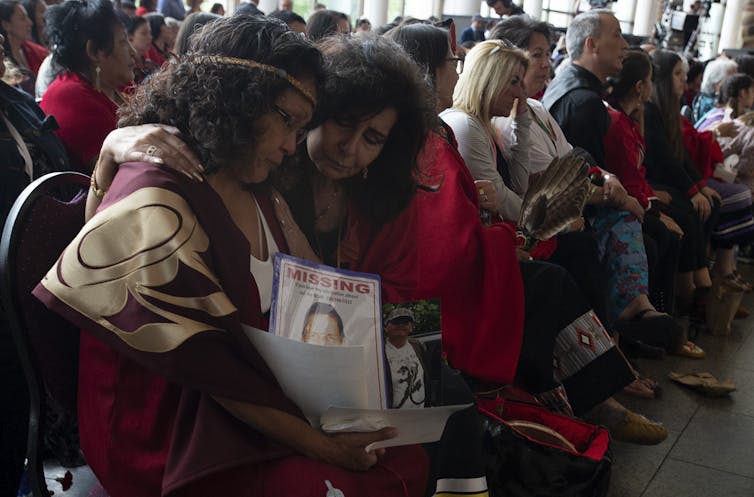
Two women embrace during ceremonies marking the release of the Missing and Murdered Indigenous Women and Girls report in Gatineau on June 3, 2019. | THE CANADIAN PRESS/Adrian Wyld
One genocide is never the same as another, and therefore a static law or a fixed concept of genocide is of little use to protect us from its horrors. Understanding genocide as a process can help Canadians grapple with the ongoing threat faced by Indigenous peoples in Canada and Indigenous women and girls as outlined in the final MMIWG report.
Legal professionals over time have had to adjust their reading of genocide law. Since the Second World War, contesting ideas and debate have brought about changes to how legal scholars and courts interpret genocide. The authors of the genocide supplement for the MMIWG report draw upon these interpretations but also pose new challenges to the laws of genocide.
These questions are necessary because the history of settler colonialism in Canada includes a variety of efforts to remove, assimilate, starve and erase Indigenous nations. When one approach failed, the settler colonial mesh recalibrated.
For example, residential schools mutated into child removals and mass incarceration. Moreover, the strands of the mesh continue to entrap and strangle communities long after the supposed end of any one manifestation of group destruction.
This is the destruction to which the report draws our attention.
Colonial and masculine assumptions are evident in genocide law, as is the political will of the drafting parties to protect their own nations from accusations of genocide, hence the withdrawal of Article III from the final document.
Despite these beginnings, the law develops as people engage with it, and genocide case law has gradually addressed some of the limitations of the UNGC.
For example, through decisions from bodies such as the International Criminal Tribunal for Rwanda, the groups protected from genocide have been expanded beyond narrow understandings of ethnicity, nationhood, religion and race.
The MMIWG final report seeks to bring a grassroots, gendered and Indigenous reading of these laws to the discussion of MMIWG and how Canada’s actions and omissions contributed to their deaths.
This is a valuable contribution and pushes the boundaries of the definition of genocide. Thinking on this topic always needs to be pushed.
Genocide is a transgressive act. It overturns all expectations, violates social norms and continuously mutates to take on new and surprising forms. Different readings and interpretations of genocide are needed to truly confront the many evolving methods of group destruction.
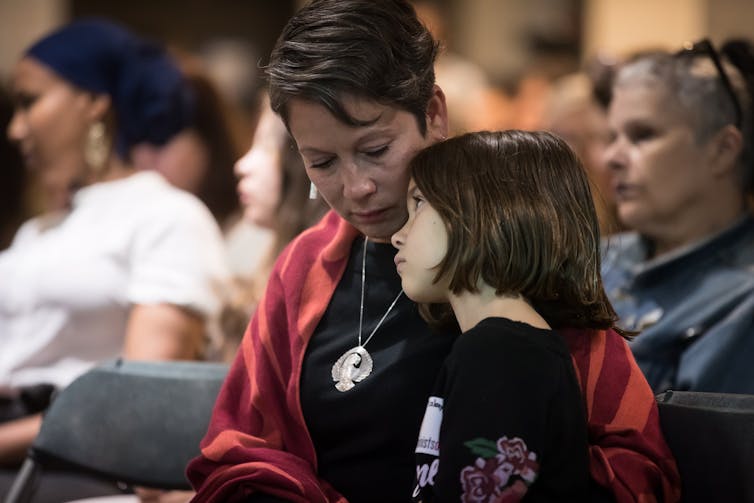
British Columbia Minister of Advanced Education and Skills Training Melanie Mark, B.C.‘s first female First Nations MLA, and her daughter Makayla, 8, listen as Indigenous women and allies respond to the report on the National Inquiry into Missing and Murdered Indigenous Women and Girls, in Vancouver, June 3, 2019. | THE CANADIAN PRESS/Darryl Dyck
Residential schools can be seen as situated within a series of nets that operated on all levels in society, including at the upper echelons of society among elite social influencers, and also through government and missionary institutions as well as individual teachers, principals and communities. There was a complex coordination of activities, habits, ideologies, motives and intents that were generally directed toward eliminating Indigenous peoples as distinct peoples.
These layers of destructive action can be likened to a settler colonial mesh constructed to entrap Indigenous peoples within an assimilative project. But the mesh is prone to snags and tears allowing for the emergence of resistance and subversion. Indigenous people were not passive; parents refused to send their children, children ran away and communities sometimes preserved their cultures when conditions allowed.
Impact on group destruction
The MMIWG report is about the results of such processes and their effects on community and family relationships: harmful relations established through settler colonialism, their impact on intimate and everyday group relations and the possibility of better relations in the future.
It demands more of genocide law, and more from Canadian society, to address the intersecting settler colonial and hetero-patriarchal wrongs that have led to the injustice of MMIWG.
Rather than staunchly defend a narrow conception of genocide, it is time to demand this concept to do what it was intended to do: enable human thriving through respectful collective relations.